UNLOCKME • PHONES THAT MADE HISTORY
A mysterious delivery. A ringing Nokia. One very satisfying snap. The story of the 8110, the 7110 and the movie trick that collectors are still chasing.
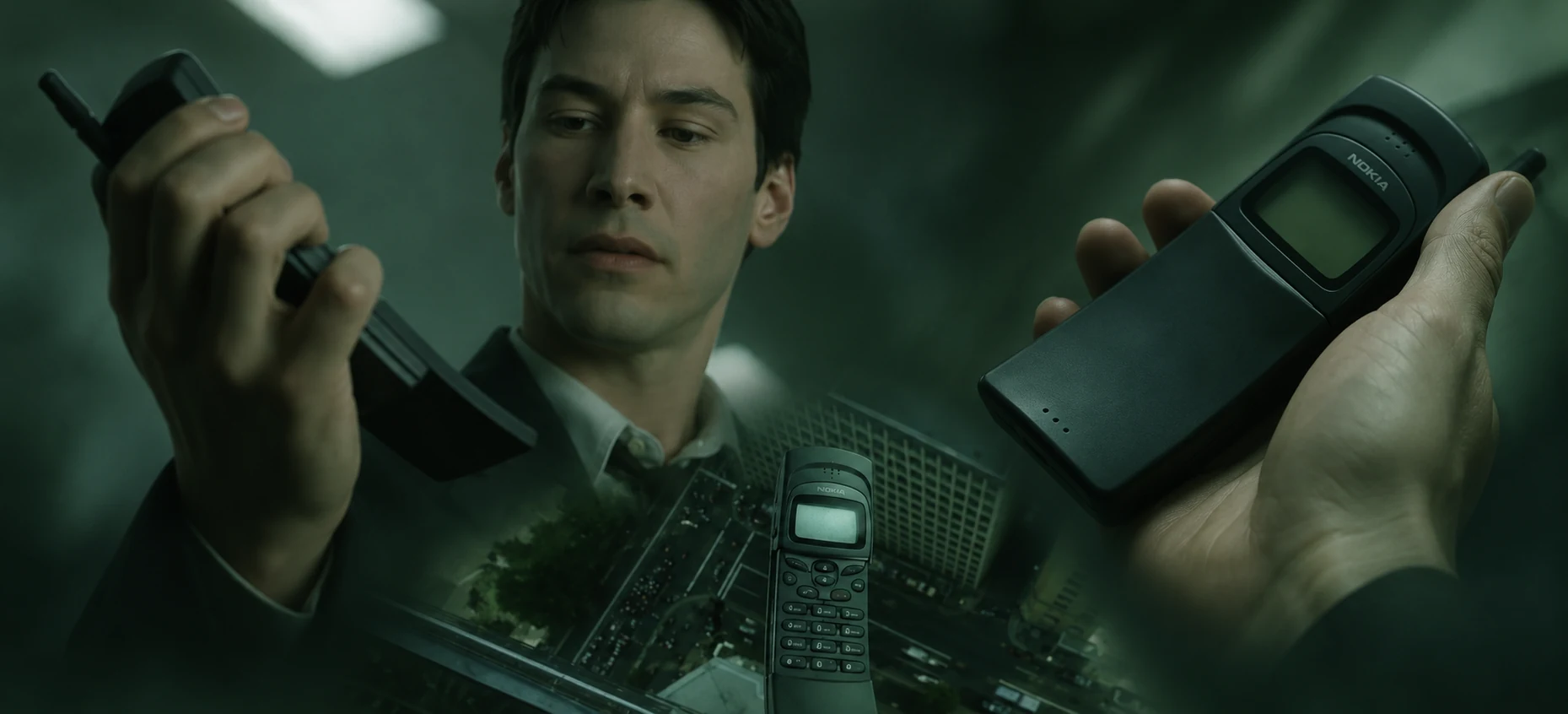
Some phones are remembered for their cameras. Some for their ringtones. This one is remembered for the way it opened.
In The Matrix, a courier delivers a phone to Neo at work. It rings, its cover snaps down, and Morpheus starts talking him through an escape. Before we have seen the red pill, the Nokia has already made the ordinary office feel like the edge of another world.
If you watched that scene and immediately wanted the phone, there was a catch. You could buy the handset. You could not buy that particular party trick from Nokia.
THE ANSWER IN TEN SECONDS
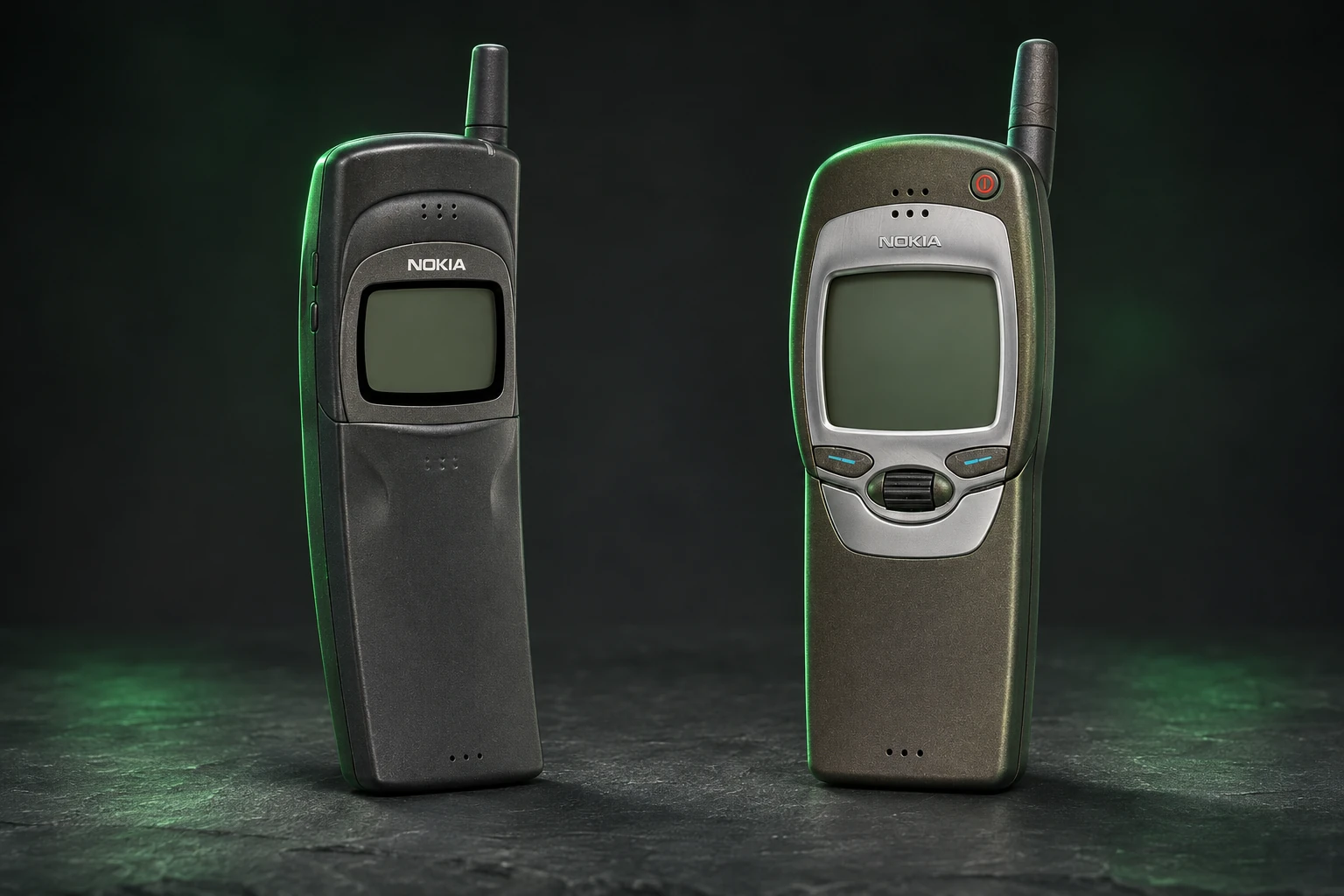
The phone in the first Matrix film (1999) was a modified Nokia 8110. The shop-bought 8110 had a manual sliding cover. The film version added the snap-open action. The Nokia 7110 had a spring-loaded cover as standard, which helps explain the confusion—but it was a different handset. [1][2]
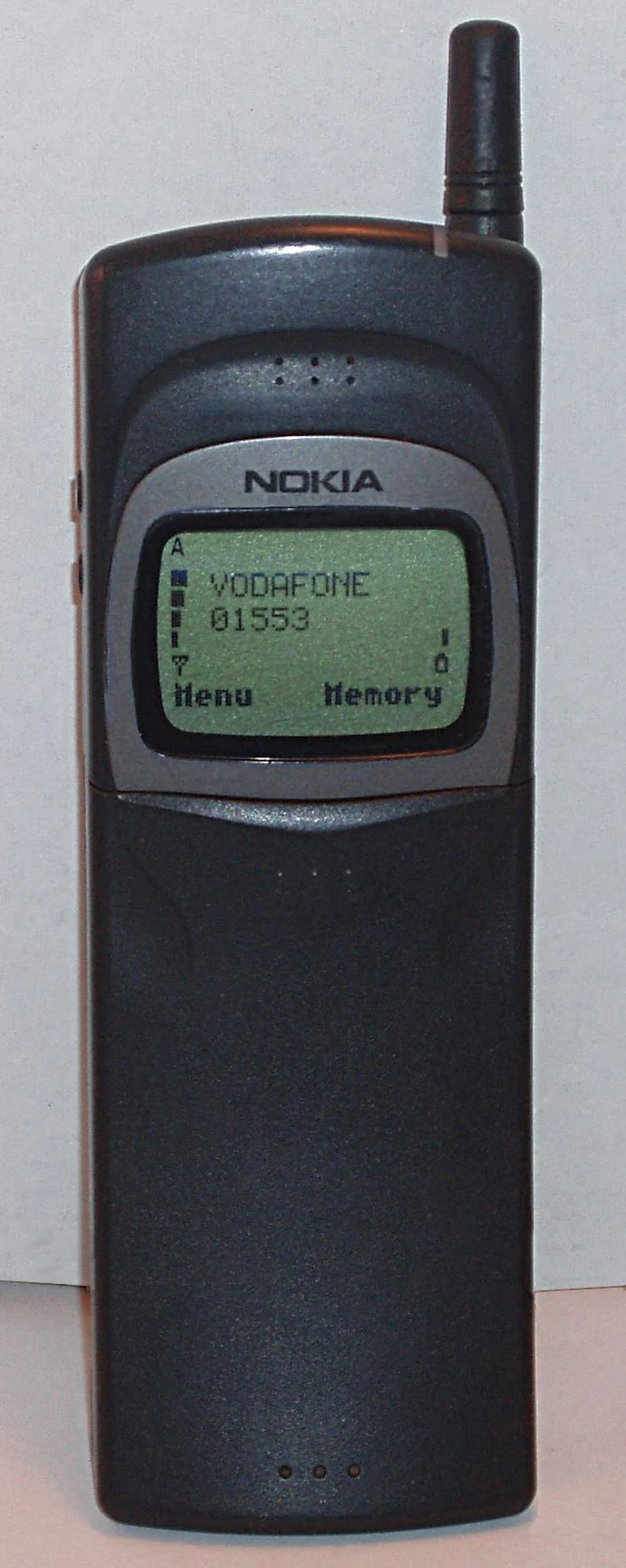
The 8110: a banana before it was a movie star
The original 8110 arrived in 1996, three years before the film. Its curved body and long sliding cover gave it an unusually distinctive silhouette. The banana nickname was almost inevitable. [1]
The cover had a practical job, too: it protected the number keys and carried the microphone closer to the mouth when extended. This was a phone designed around a conversation, with a physical beginning and end. Opening it felt deliberate; closing it felt final. [1]
That is part of what makes the office scene work. The handset is recognisably an everyday object, yet the sudden movement makes it feel as if it belongs to someone who knows more than Neo does. There is no need for a futuristic screen full of graphics. The prop does its work with a piece of moving plastic.

A normal phone, an extraordinary entrance
The important distinction is between the retail phone and the film prop. The Mobile Phone Museum records a custom spring-loaded mechanism for the movie, never offered on the commercial 8110 family. [1]
The spring is well documented. The workshop story is a little hazier: we could not pin down exactly who fitted it, which parts they used, or whether every prop had the same internals.
It is also worth keeping “8110” and “8110i” separate when buying. A listing for the later family variant is not evidence that the handset has the film’s opening mechanism.
Why the 7110 gets the credit
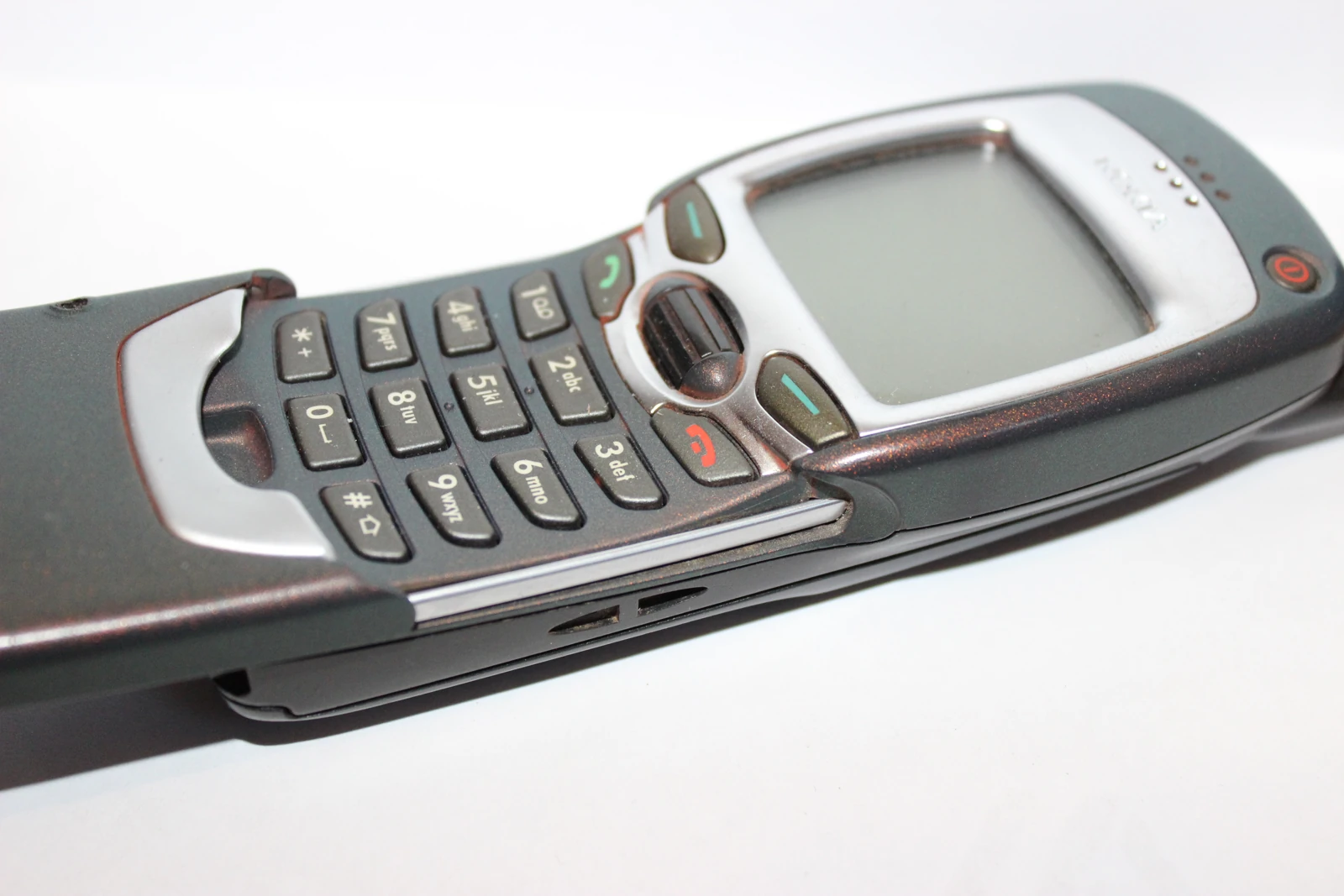
The 7110 delivered the action people remembered: press the release button on the back, near the antenna, and the cover springs down. It also looks just similar enough to make a memory-based identification tempting. [2]
Look closer and the differences become obvious. The 7110 has a much larger display, a silver surround and a prominent NaviRoller beneath the screen. That little wheel is the quickest giveaway. Neo’s 8110 does not have one.

The dates spoil a good story
It is often said that the film became such a hit that Nokia created the 7110’s spring-loaded slider in response. The chronology does not support that version: Nokia announced the 7110 on 23 February 1999; The Matrix opened in the US on 31 March. [3][4]
This does not rule out contact during the film’s production. It does mean we should not present audience demand after the cinema release as the explanation for a product already announced.
| Phone | How the cover opens | Its place in the story |
|---|---|---|
| Nokia 8110 Retail, 1996 | Slide it down manually | The original handset design |
| Modified 8110 Film prop, 1999 | Custom snap-open mechanism | The phone seen in the original film |
| Nokia 7110 1999 | Factory-fitted spring release | The real-world snap; a different phone |
| Nokia 8110 4G 2018 | Manual slider again | A later revival, not the original hardware |
The 7110 deserves its own place in history
Being mistaken for a film prop slightly undersells the 7110. Nokia’s original announcement was about putting internet services in your pocket. It introduced the handset as the first WAP-based media phone, with a large graphics display, predictive text and that clickable roller. [3]
The examples tell you exactly where mobile internet was heading in 1999: news, weather, stock prices, flight information and banking. Nokia even announced a CNN Mobile news service alongside the phone. This was compact information designed for a small handset, rather than the full visual web we expect today. [3]
The Mobile Phone Museum also identifies it as the first handset with Nokia’s Series 40 user interface. The 8110 won a place in cinema history; the 7110 was helping to change what people expected a phone to do. [2]
Could you buy—or build—a proper snap-open 8110?
This is where the story becomes wonderfully old-school: message boards, tiny video attachments and people working out how to fit a movie moment inside a real phone.
First, decide what you want to own. The words “Matrix phone” can describe several very different things, and a snappy slider does not tell you whether a handset can make a call.
Film props: buy the history, then check the handset
An authentic production prop is a different purchase from a modified Nokia. Ask for the auction record, accompanying paperwork and the history linking that particular object to the film. “Production-made”, “screen-used” and “replica” are different claims; none automatically means it still works as a telephone.
The headline-grabbing claim is US$32,500 to over US$57,000 for genuine 8110 film props. That range came from an AI research summary, and we could not confirm it against matching completed auction records. Treat it as an unverified claim, rather than an established price guide. Before spending that sort of money, you would want the exact auction lot, its provenance and a clear explanation of whether the figure includes fees.
Even catalogue headings can trip you up. One Heritage entry says Nokia in its title, but the description is for ten retail Samsung Matrix Reloaded phones, and the lot is marked unsold. It tells us nothing about what Neo’s original Nokia might fetch. [11]
A documented enthusiast conversion
On 7 December 2003, HowardForums member Greensheepuk03 announced his finished autoslide conversion in a thread titled “Nokia 8110 Autoslide Matrix Modification – Finnished!” The thread lists a video attachment, final.wmv, and a photograph of the release mechanism. He says the project was already posted in the modifications section, linking the announcement to his more detailed “Major 8110 Matrix Mod” discussion. [5]
The important detail appears in post 11 of that earlier thread, dated 8 December. Asked where he fitted the springs, the maker replies: “Mine doesnt actually use springs.” He describes a rubber band pulling the cover open and a small spring clip holding it shut. Pushing the clip releases the cover; he also filed the slide tracks slightly to reduce friction. [5]
Proper old-school tinkering—and a real physical modification. The distinction is between the part that pulls the cover open and the catch that releases it. A spring clip does not establish a transplanted 7110 mechanism, and these two threads do not document one. The old video attachment is listed, but we have not independently replayed it or tested the handset.
A tantalising Blackpool sales story
There is an earlier lead on sales. In a March 2001 Usenet discussion, a poster signing himself David recalled buying an aftermarket 8110 case with a spring-loaded slider from a stall on Blackpool promenade the previous year, for a friend. [6]
It is a lovely little lead, although we only have the buyer’s recollection to go on. There is no named stall, manufacturer or surviving product page to follow up. If you remember those cases, we would love to hear more.
What we can say: an enthusiast conversion is documented, and spring-loaded aftermarket cases were reported as being sold. As of 8 November 2026, our search did not locate a current seller we could verify as supplying a working, button-release original 8110.
Many listings use “Matrix phone” simply to describe an ordinary 8110. Those words alone do not mean it has been converted.
Just want one for the shelf?
A display replica or dummy may suit a collection perfectly, provided the listing is clear about what it does. Check whether the cover moves, whether it opens automatically, and whether there are any electronics inside. A 3D model download is also a different purchase from a finished physical prop.
Collector galleries need reading just as carefully as shop listings. A YourProps entry labelled “replica movie prop” describes its 8110 as an authentic Nokia handset in the owner’s collection. The page does not establish a spring conversion or a current sale. Treat it as a reference, rather than a source of guaranteed working replicas. [12]
What to ask a seller
Ask for one continuous video showing the exact handset closed, the release button being pressed, and the cover opening without a hand pushing it. If it is advertised as a working phone, ask for a separate demonstration of its phone functions, including the microphone and earpiece. A beautiful display prop and a usable conversion are different purchases.
Ask what powers the mechanism, whether it can be serviced, and whether the housing is original. “Screen-used” needs its own provenance: a clever conversion does not become a film prop simply because it recreates the movement.
The 2018 banana nearly got its spring
HMD brought the name back with the Nokia 8110 4G in 2018, offering black and a very literal banana yellow. It revived the curved shape and sliding cover, with much newer mobile hardware underneath. [10]
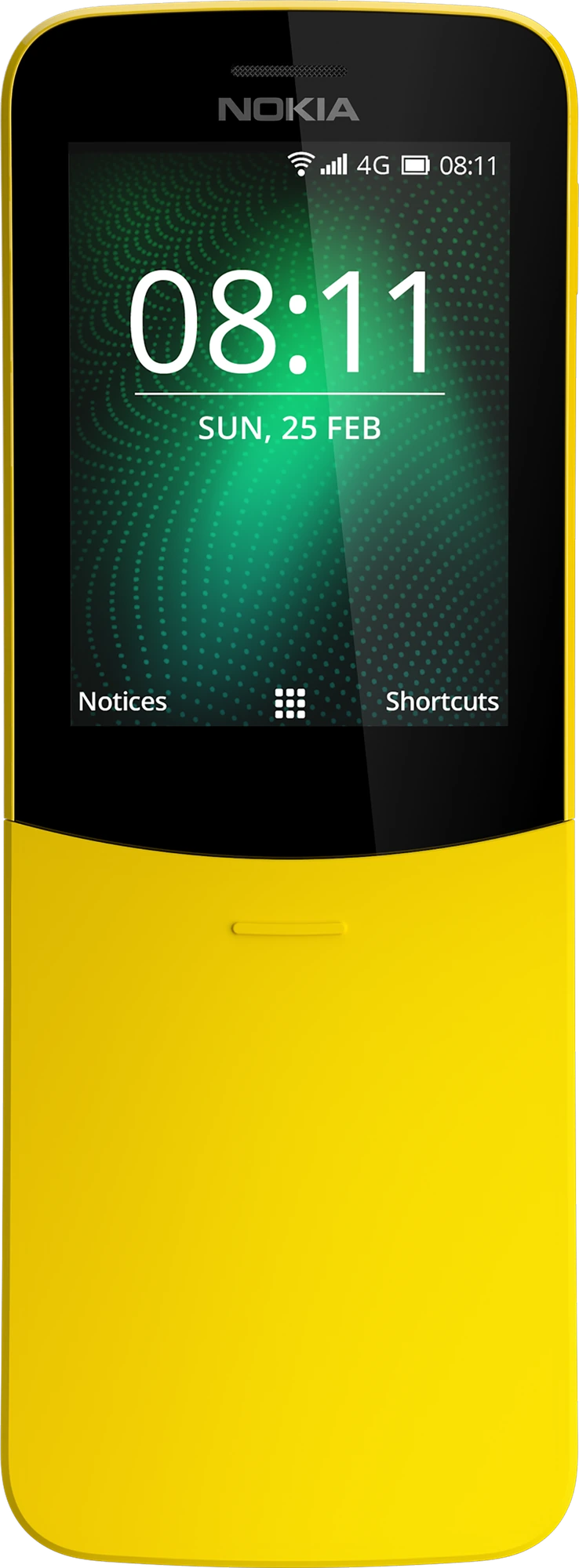
The remake kept the manual slider
The especially good detail is that a spring release was seriously considered. In an interview with TechRadar, HMD’s then chief product officer Juho Sarvikas said the mechanism would have made the design almost two centimetres wider. The team explored both versions and chose the more compact manual design. [9]
So the remake stayed closer to the original shop-bought phone than to the screen memory. Even twenty years later, fitting that little moment of cinema into a practical handset involved compromises.
And those hoped-for aftermarket spring kits? We could not find a readily available one for the 2018 handset. Someone may have made their own, but if the snap is the reason you are buying, ask the seller to show it working.
Why we still want one
The attraction is easy to understand. A modern phone can do almost everything the 8110 cannot, but answering a call rarely feels like an event. The Matrix made one small mechanical movement feel like an invitation.
For the original silhouette, look at the 8110 family. For the factory-built spring action, the 7110 is the obvious Nokia to explore. For both together, you are back in the world of individual conversions—and asking good questions.
And if anyone has a surviving example of those Blackpool spring-loaded cases, we would love to see it. That is exactly the sort of missing piece of mobile-phone history worth keeping.
ONE LAST CALL • THE LATER FILMS
And then Samsung made the phone look like science fiction
The original Nokia 8110 is the signature handset of the first film, The Matrix (1999). It did not carry on as the main phone in The Matrix Reloaded and The Matrix Revolutions, both released in 2003. The sequels went for a much more futuristic design, and the Samsung SPH-N270 brought that look to a real retail phone as a Reloaded tie-in. [7][8][13]
There was a proper commercial partnership behind the change. Samsung’s own annual report describes its deal with Warner Bros. and Village Roadshow, with phone product placement forming part of a DigitAll Matrix campaign worth over US$80 million. That was the wider campaign budget, covering several Samsung products; it was not a stated fee just for putting this handset on screen. [15]
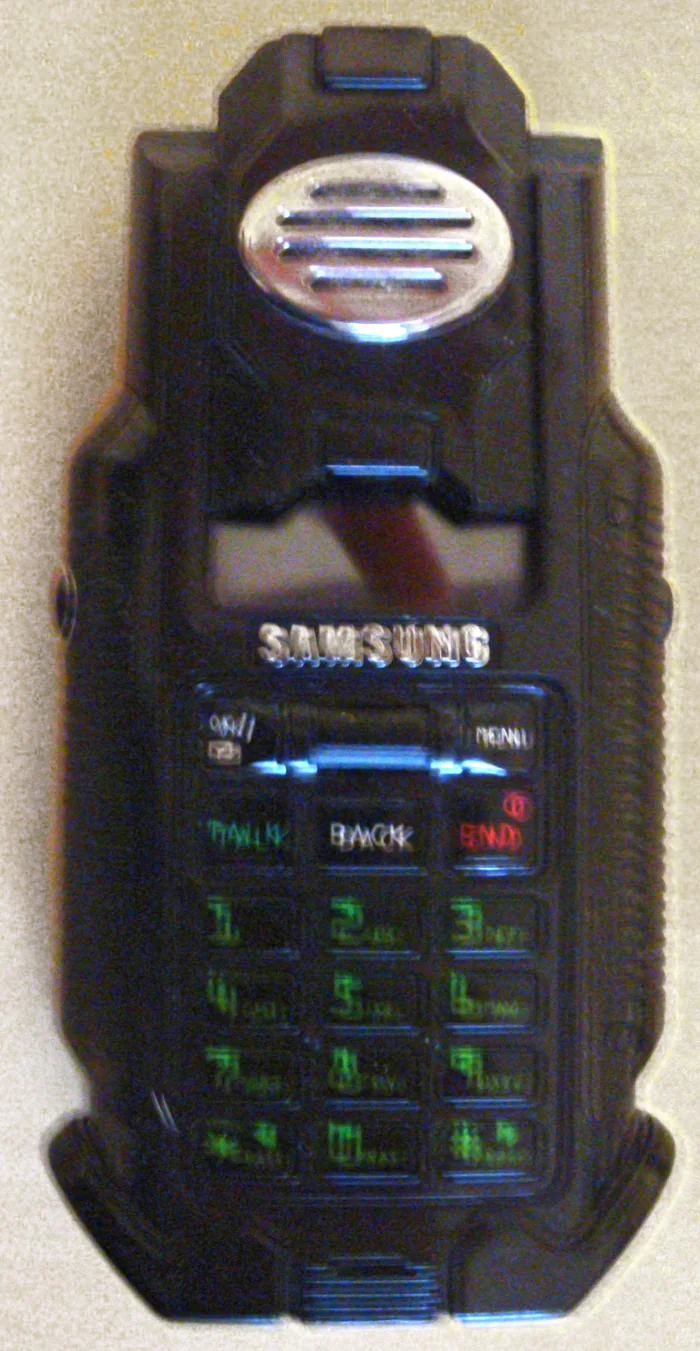

The movement went upwards
Its big mechanical moment was the pop-up earpiece. Rather than dropping a cover away from the number keys, the Samsung lifted the speaker section to expose more of the colour display. With its chunky black body, silver grille and green details, it looked much more like a piece of equipment from the film’s world. [14]
The retail phone was a real product for the US Sprint PCS service. Its AMPS/CDMA hardware means it is not a handset you can simply put a UK GSM SIM into. For a British collector, the attraction is the object and its movie connection. [14]
A small run with a big following
And yes, there is a basis for that often-repeated 10,000-phone figure: auction house Propstore describes a limited run of 10,000 SPH-N270s made as promotional tie-ins. Its sealed example was a gift to a corporate partner, so that does not mean 10,000 were sold over shop counters. We have not found Samsung’s own production tally, so we are attributing the number to the catalogue. A boxed example is certainly a lovely little piece of Matrix memorabilia. [16]
“Working” meant something different on set
In an archived interview, sequel prop-maker Kevin McManus described building three hero phones with functioning opening mechanisms and lights, along with fixed-open, fixed-closed and rubber stunt versions. The hero keypads were not active. His account concerns the film props; it should not be confused with the capabilities of the retail Samsung. [8]
That is the lovely distinction between the two generations. The first film made an ordinary Nokia feel extraordinary. The sequels went further and gave us a phone that looked as though it had escaped from the props department.
By 2021, even the exit had changed
By The Matrix Resurrections (2021), even the way out had changed. In the earlier films, mobiles let the characters talk to their operator, while hardlines provided their exits. The fourth film gives the resistance portals, including mirrors, so escaping no longer means a desperate dash to a phone booth. Bugs even points out the change to Neo. [17]
There may be a small Nokia callback, too. NokiaMob spotted a black 8110-style handset in the opening recreation and suggested it was HMD’s 2018 Nokia 8110 4G. The report noted that Nokia Mobile had not confirmed the identification. It is a fun possible nod to the original, but the exact model remains uncertain—and the report does not identify a yellow handset. [18]
So the neat version of the story is: the original Nokia made its name in the 1999 film, Samsung supplied the distinctive retail tie-in for the 2003 sequels, and the fourth film revisited the old imagery while giving its characters a new way to escape.
Sources & further reading
Researched 8 November 2026. Primary announcements, interviews and contemporary posts are linked below. Collector accounts are identified as accounts, rather than treated as independently verified sales.
- Mobile Phone Museum: Nokia 8110 — collection record, design and film modification.
- Mobile Phone Museum: Nokia 7110 — spring release, NaviRoller and Series 40.
- Nokia’s 23 February 1999 press release — archived copy of the original announcement.
- AFI Catalog: The Matrix — US release on 31 March 1999.
- HowardForums: Major 8110 Matrix Mod — especially the maker’s 8 December 2003 explanation in post 11; his 7 December finished-mod announcement lists final.wmv and a release-mechanism photograph. These describe the same project.
- alt.cellular.nokia: “the matrix phone” — David’s corrected 11 March 2001 post about the Blackpool case.
- RCR Wireless, 16 April 2003 — contemporary Samsung announcement report; Phone Scoop’s March 2003 FCC report identifies the N270.
- Kevin McManus, November 2001 — official Matrix-site interview preserved by Matrix Fans.
- TechRadar’s HMD interview — the spring-release 2018 design that did not ship.
- HMD launch announcement, 25 February 2018 — press release reproduced by NokiaMob.
- Heritage Auctions, lot 89666, July 2022 — title says Nokia; description specifies commercial Samsungs; result is Not Sold.
- YourProps: Nokia 8110 Cellphone — collector’s own description; gallery evidence, not an authenticated film prop or verified sales offer.
- Mobile Phone Museum: Samsung SPH-N270 — 2003 handset collection record and Reloaded association.
- Samsung / Sprint SPH-N270 user guide — original manufacturer’s manual, archived by ManualsLib; Samsung FCC filing and manual confirms AMPS/CDMA hardware.
- Samsung Electronics 2004 annual report — printed page 33: the Reloaded partnership, product placement and wider campaign spend.
- Propstore, lot 932: sealed promotional SPH-N270 — catalogue description gives a 10,000-phone run and identifies this example as a corporate gift; not a manufacturer production record.
- The Matrix Resurrections transcript, archived by Matrix Fans — Bugs explains that phone-booth exits are no longer necessary; the train escape uses a mirror.
- NokiaMob, 29 December 2021 — tentative identification of a black 8110 4G in the opening sequence, explicitly without official confirmation.