
Trading a glass slab for a pink RAZR gets you something no screen-time setting can offer: a phone you can snap shut and put away. Real buttons. A proper hinge. A device that feels finished when the call is over.
That is the appeal of the dumbphone revival. For Gen Z, these phones can be a first encounter with a world before endless feeds; for millennials, they are an old friend. Plenty of today’s budget basic phones do the job, but the best hardware from this era had personality. You chose a phone partly because you liked picking it up.
This guide takes “Y2K” in the generous, nostalgic sense: late-1990s classics, mid-2000s experiments and one much-loved 2011 BlackBerry. Some make lovely weekend phones. Others are now mainly collector’s pieces. Here is what we would look for, what we would budget, and what still works.
Before you buy: these original handsets depend on old networks or discontinued services. Read the UK network check before choosing a SIM. All product pictures here are AI-created illustrations based on handset references, so judge an eBay purchase by the seller’s own photographs.
Choose your kind of switch-off
| You want… | Start here |
|---|---|
| The simplest weekend phone | Original Nokia 3310 or 6310i |
| Something tiny for your pocket | Original Nokia 8210 |
| Music without a feed | Sony Ericsson W800i / W810i |
| A little 2000s theatre | Hot-pink RAZR V3 or Nokia 7110 |
| A pocket design object | Nokia 7280 or 7600 |
| A keyboard to enjoy offline | BlackBerry Bold 9900 — with important caveats |
| A display-shelf conversation starter | Sidekick 3 or N-Gage |
About the prices: these are rough UK buying budgets, checked against eBay asking prices on 8 November 2026—not averages of completed sales. Aim for a tested, usable handset unless the profile says otherwise. Postage, batteries and accessories may cost extra; boxed originals and rare finishes can cost much more. “Powers on” and “fully working” are different promises.
1. Cultural icons · 2. Nokia gets weird · 3. The heavyweights · 4. Before you buy
1. The Y2K cultural icons
Motorola RAZR V3: hang up in hot pink
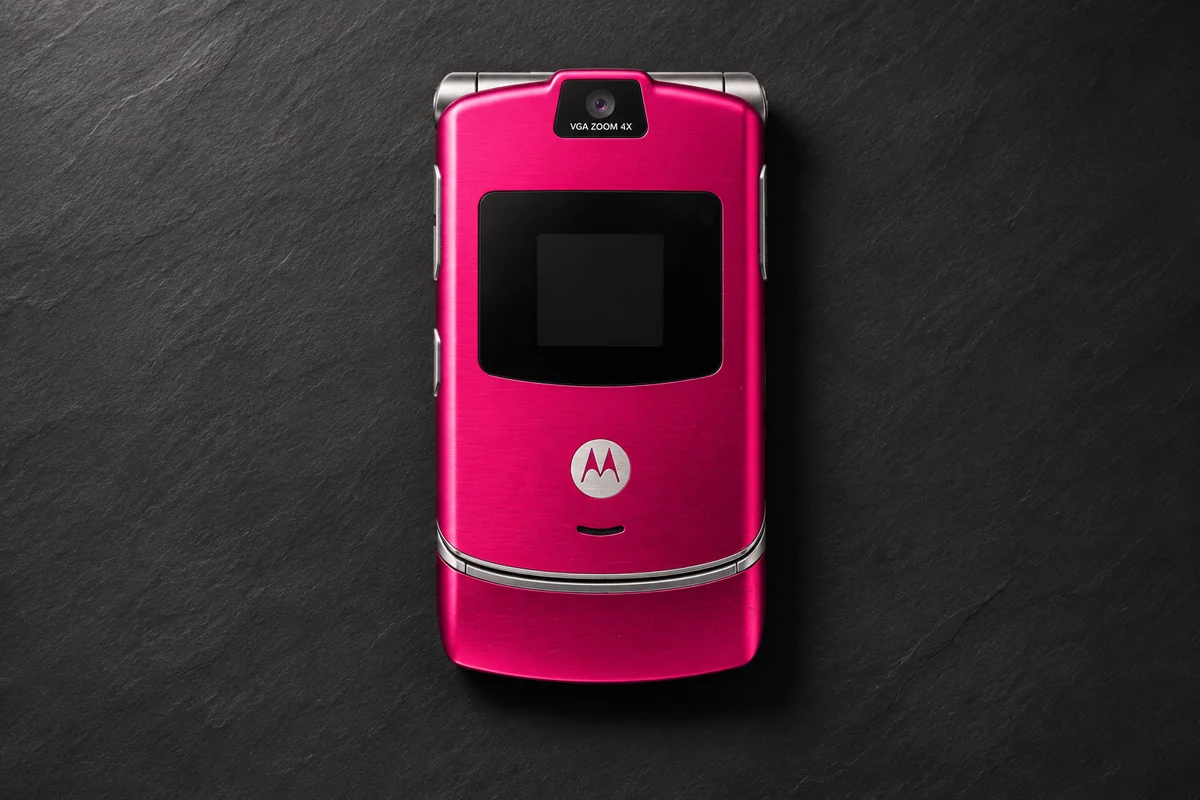
Buying budget: £25–£60; clean original pink examples can be higher · Check eBay listings
The RAZR V3 is peak mid-2000s confidence. That startlingly thin metal body, the etched keypad and the pink finish still look deliberate rather than dated. The V3 arrived in 2004; the pink version followed, with an early UK exclusive through Carphone Warehouse. [5]
Its best detox feature is the hinge. Finish a call, snap it shut, done. You can text and take a gloriously modest photo, but there is very little here that invites you to lose an hour. It is a particularly good choice if you want your basic phone to feel like a treat.
Check before buying: hinge play, cracks around the hinge, both displays and charging. Ask whether the pink housing is original or a replacement shell. Buy the original GSM V3 deliberately; similar-looking RAZR models are not all the same phone.
Motorola StarTAC: calls, with a little Wall Street
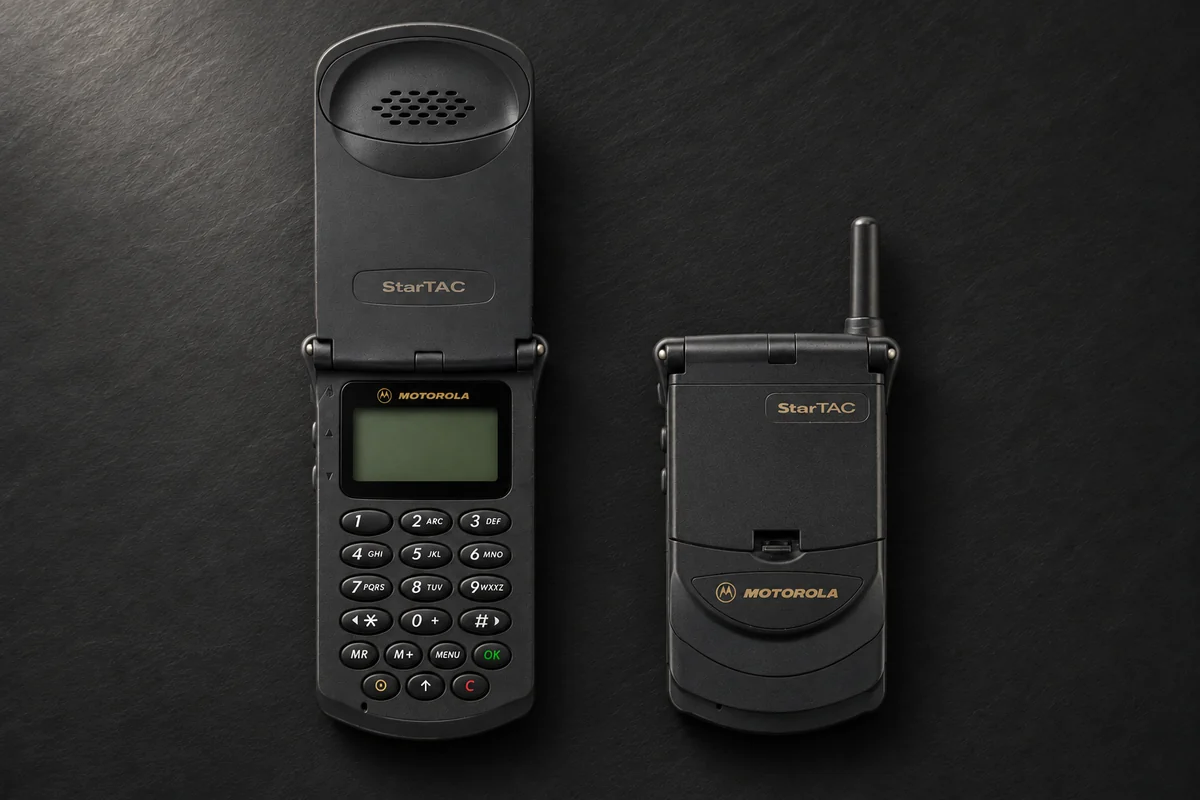
Buying budget: £50–£150 for a suitable GSM example · Check eBay listings
The StarTAC family began in 1996, before Y2K had even happened. It has the feel of a late-90s executive accessory: small, serious and ready to disappear into a jacket pocket. Open the clamshell and there is only the bare minimum waiting inside. That restraint is the attraction. [6]
For a detox, it is about as direct as a mobile gets. But buy the right version. StarTAC was a family name used across different network technologies; an analogue or CDMA example can look wonderfully convincing and still be useless on a UK SIM.
Our buying rule: confirm the exact GSM model and supported bands, then ask for a recent call test. The photograph illustrates the GSM StarTAC 130. A seller saying “vintage Motorola” is not enough. Check the battery latch, antenna and availability of a suitable replacement battery too.
Nokia 8210: when smaller meant cooler
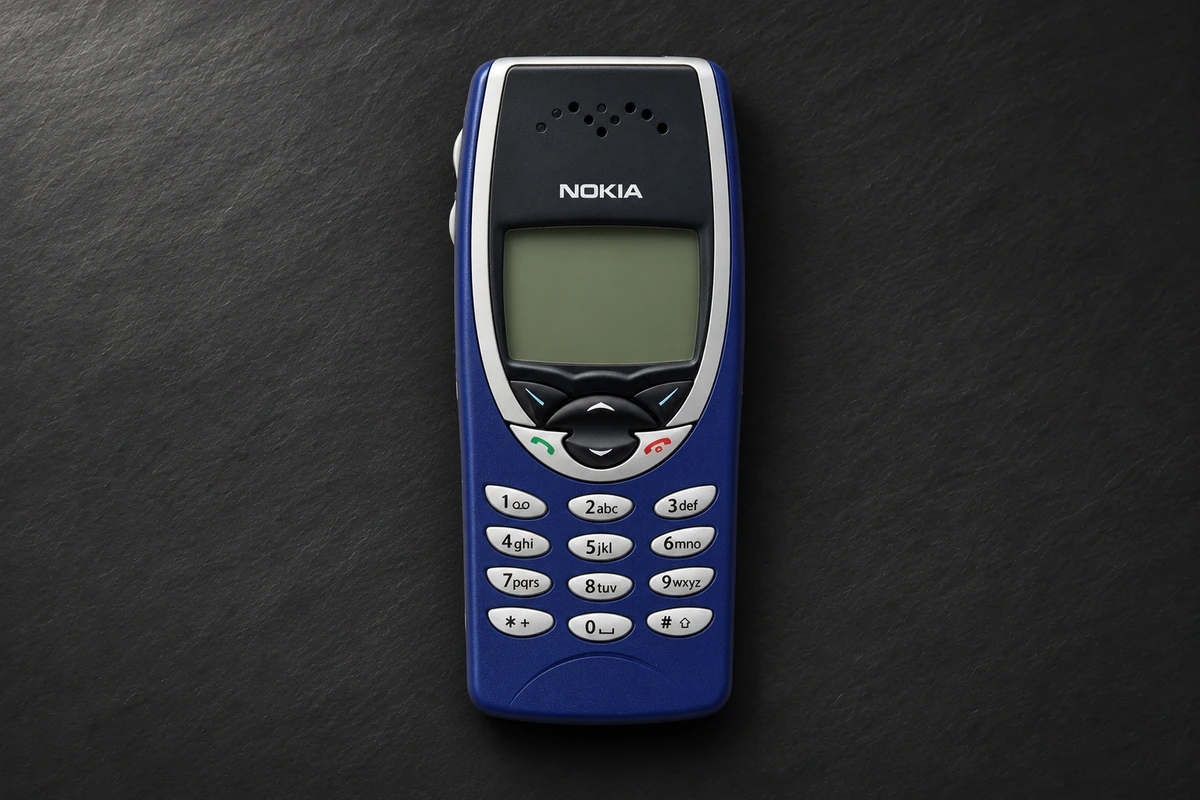
Buying budget: £35–£80; boxed originals can cost considerably more · Check eBay listings
There was a time when the exciting new phone was the one that took up less of your pocket. The 1999 Nokia 8210 captures that perfectly: just 79g, a neat little body and coloured covers you could swap to suit your mood. In blue, with those tiny silver keys, it still looks like something you would choose because you liked it. [39]
For a weekend detox, the appeal is simple: calls, texts and a little Snake, wrapped in a phone you can almost forget you are carrying. Predictive text helps those small buttons along, while infrared adds a lovely period detail: two compatible 8210s can even play Snake head-to-head. It is a small pleasure, not a reason to keep scrolling. [38]
Buy the right 8210: this is the original 2G handset, not the much later Nokia 8210 4G. There is no Bluetooth or Wi-Fi; check the UK network advice before choosing a SIM. The original is about the charm of having less in your pocket.
Check before buying: ask for a clear photo of the display switched on, with no missing lines or faded patches. Test every tiny key, calls and charging, and check the battery cover fits securely. Find out whether the fascia is original or a replacement, and ask how long the BLB-2 battery actually lasts. A fresh-looking shell tells you very little about the phone underneath.
BlackBerry Bold 9900: the pocket notebook
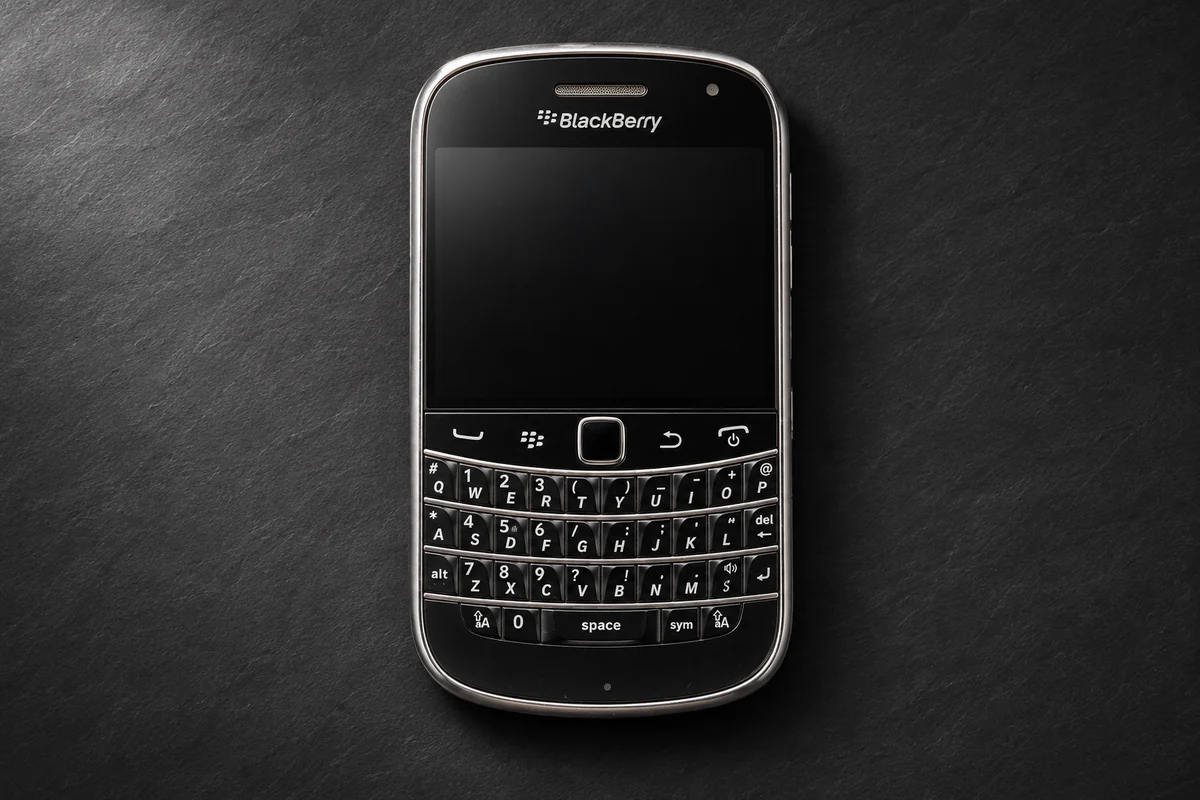
Buying budget: £30–£60, bought for verified offline use · Check eBay listings
Yes, it is a 2011 smartphone sneaking into a Y2K guide. We are letting it in for the keyboard. The Bold 9900’s wide, sculpted keys and metal frame make it a lovely thing to type on. “Best mobile keyboard ever” is a personal verdict, but this one has a very strong case. [7]
Think short notes, ideas and a distraction-free bit of writing on a unit whose local apps already work. Think pocket notebook rather than a replacement for your laptop. Test how you will save and get those notes off the phone before deciding it is your new writing companion.
The catch is bigger than lost email. BlackBerry ended legacy services on 4 January 2022 and warned that affected phones would no longer reliably support functions including calls and texts. Buy a working, already-set-up example for the offline features you have seen demonstrated. Do not rely on it as your main or emergency phone, or assume a factory reset will be painless. [3]
Sony Ericsson W800i / W810i: bring your own soundtrack
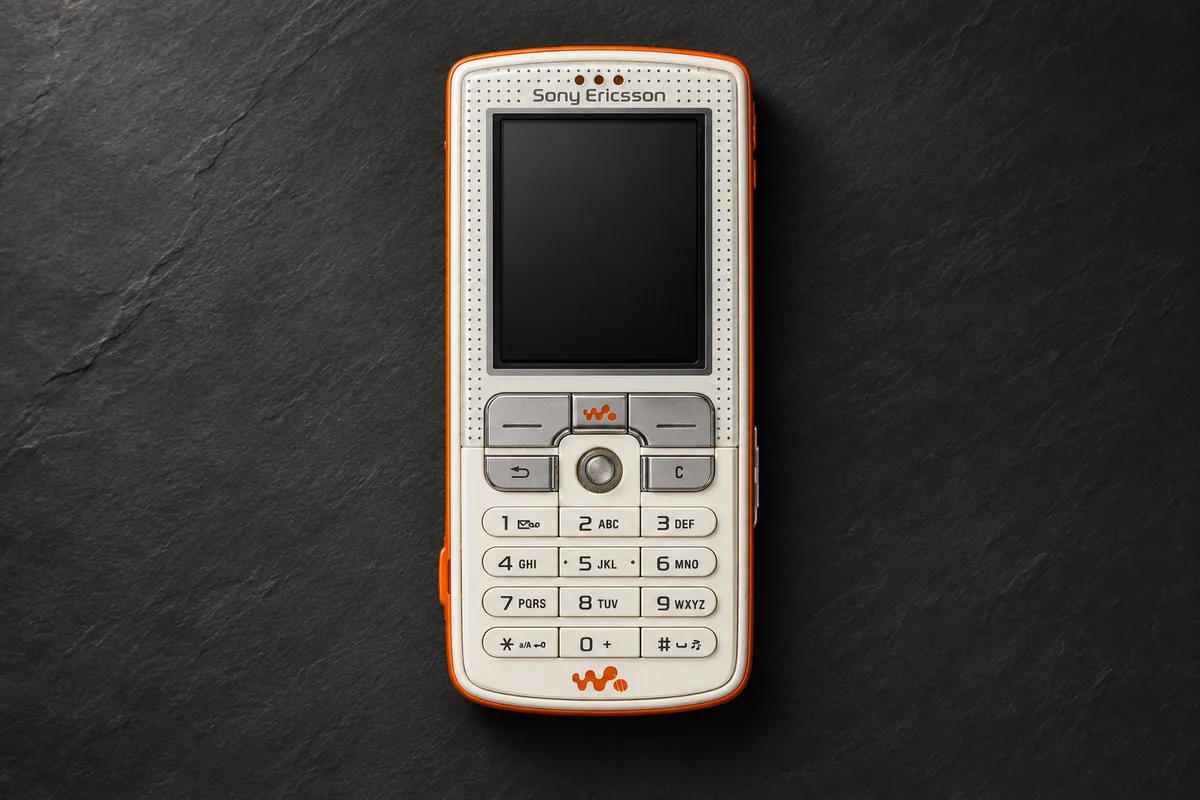
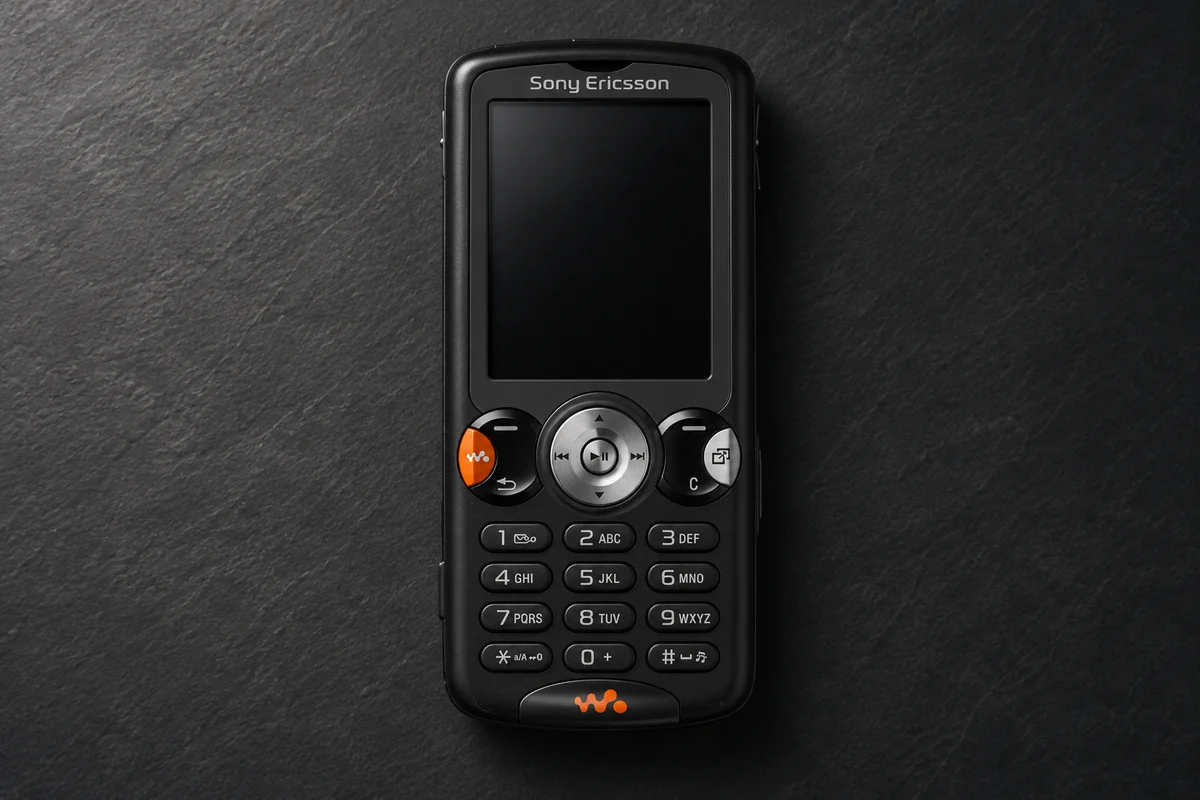
Buying budget: £30–£75, depending on model and accessories · Check eBay listings
Before one device swallowed everything, the Walkman phone made a very good argument for leaving the separate music player at home. The 2005 W800i wears white and orange proudly. The 2006 W810i is the quieter black alternative, with a proper directional control and music shortcuts. Both put listening near the centre of the experience. [8] [9]
This is our favourite idea for a music-led detox: load a few albums, plug in headphones and leave the recommendations feed behind. The dedicated Walkman button and playback controls make music feel like a purpose, not another app to open. Your own MP3 collection is the attraction; do not buy expecting today’s streaming services.
Look for the complete little kit: a working charger, data cable, suitable Memory Stick PRO Duo card and the correct headset or FastPort-to-3.5mm adapter. These are not microSD phones. Test the W800i’s joystick, the W810i’s navigation pad, and the connector with the headphones attached. A cheap bare handset can become the expensive option once you chase the missing bits.
T-Mobile Sidekick: the MySpace-era status symbol
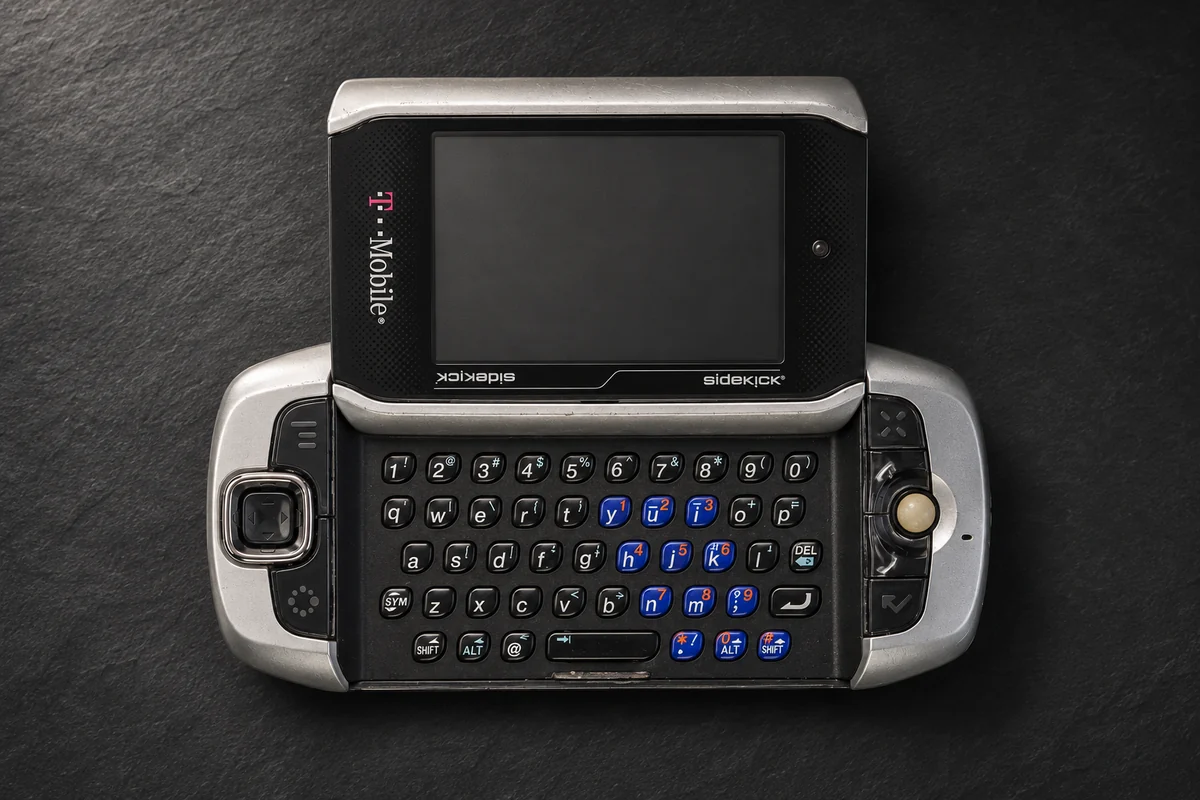
Buying budget: allow £100–£300 for a Sidekick 3; unusual editions can exceed that · Check eBay listings
The Sidekick belonged to the world of MTV, instant messaging and very carefully arranged MySpace profiles. Flick the screen around and a full keyboard appears. Even now, the mechanical swivel feels like a party trick you want to repeat. The Sidekick 3 shown here arrived in 2006. [10]
It is also the clearest case of buying the object rather than the old experience. The Danger cloud service closed after 31 May 2011. The email, messaging and online features that made these phones special are gone, and setup or activation can be awkward on surviving units. [4]
Buy it as a collectible first. Have the seller demonstrate the actual menus and offline functions you want. Do not assume that “unlocked” restores the servers or makes a US handset usable on your UK network. Check the swivel and trackball carefully. The later Android-based Sidekick 4G is a different proposition, despite sharing the name.
LG Chocolate KG800: a little black club accessory
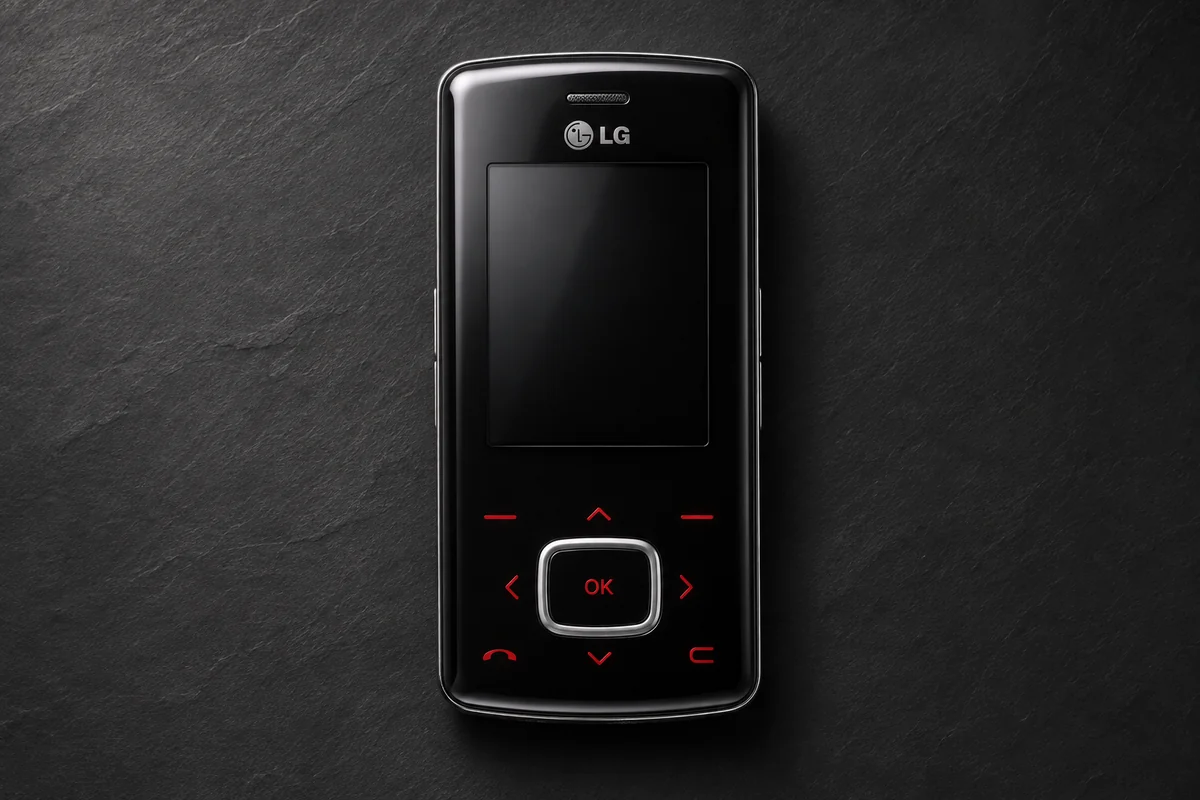
Buying budget: £20–£50 · Check eBay listings
Glossy black. A slim slider. Red touch controls that seem to appear from nowhere. The Chocolate’s 2006 appeal is still easy to understand: it looks like something you would place beside a drink in a dimly lit bar, then spend the evening trying not to scratch. [11]
The controls disappear into the dark face when their illumination is off; opening the slider reveals a normal physical number pad. It makes calls and texts feel like small, deliberate actions. There is no great urge to browse the web on it.
Check before buying: every touch control, the sliding action and the screen while moving the slider. Ask for clear photos of the glossy front in daylight. An immaculate-looking stock photo tells you very little about the scuffed phone that may arrive.
Samsung D500: the sensible one you still want
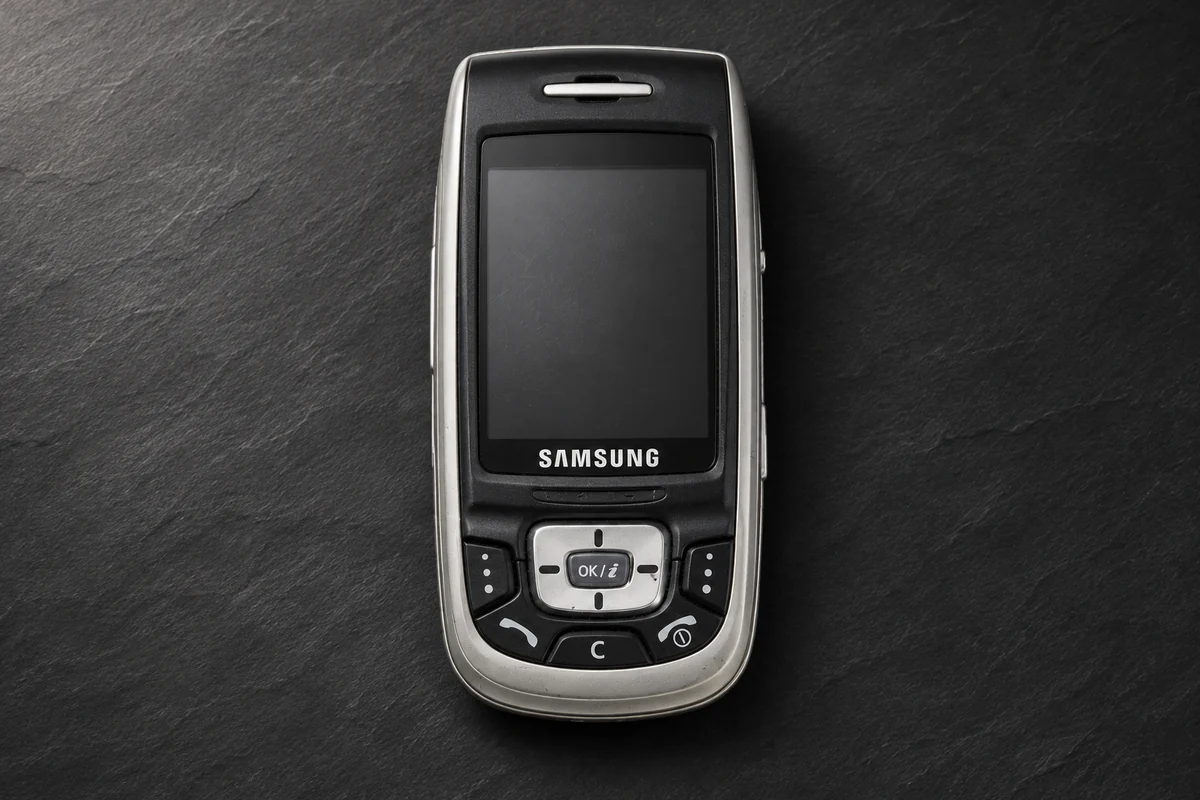
Buying budget: £25–£50 for a tested example · Check eBay listings
If the pink RAZR is making an entrance, the D500 has already found a seat. This compact 2004 slider feels tidy, substantial and properly thought through. It is a useful reminder that a premium phone did not have to shout about itself. [12]
For everyday detox duty, that is a strength. There is a conventional keypad under the slide, a colour screen, a basic camera and enough familiar phone functions to make the switch manageable. It feels like choosing a smaller tool for the job.
Check before buying: smooth slide action, a display that stays stable as the phone opens, and a battery cover that clips on securely. Confirm that a compatible charger is included. This is another phone from before USB-C made the drawer of mystery charging leads slightly less necessary.
2. Nokia’s wonderfully weird design era
Before the touchscreen rectangle became the default, Nokia seemed willing to ask almost any question about what a phone should look like. Could it be jewellery? A games console? Something you twisted in your hand? The answers were not always comfortable. They were rarely boring.
Nokia 7280: the lipstick phone
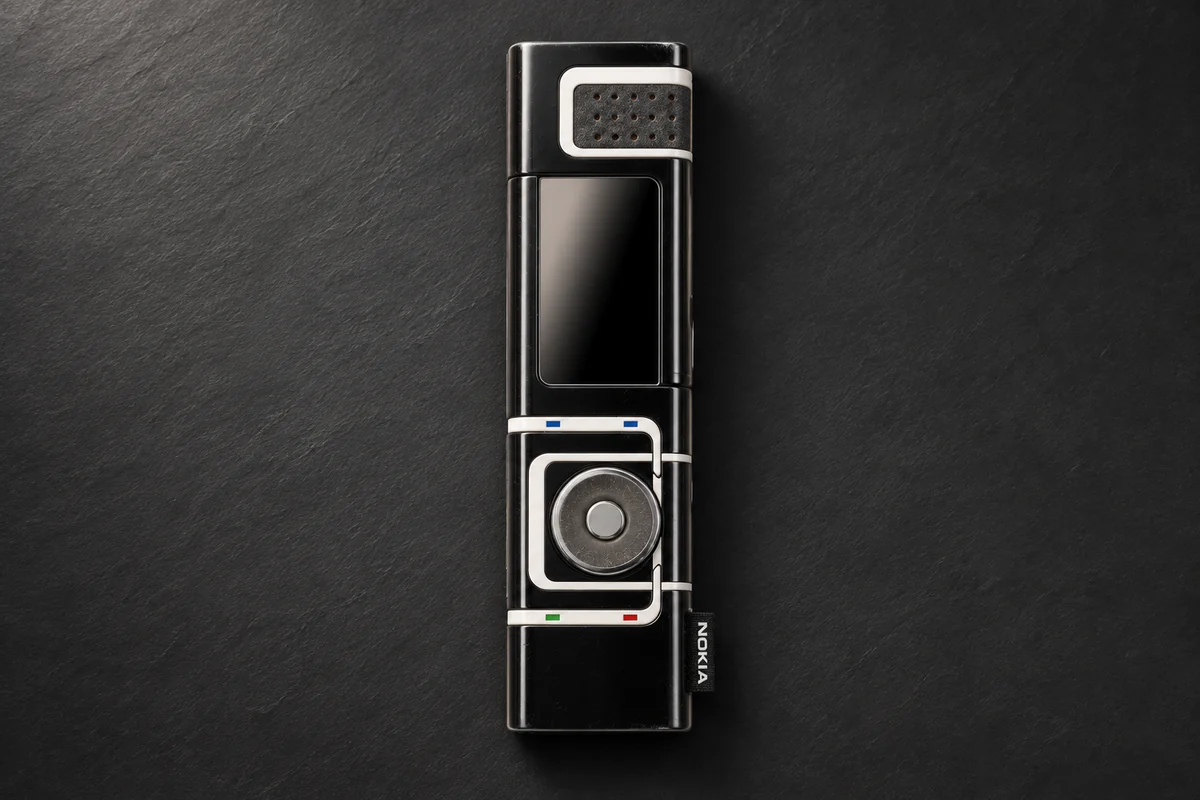
Buying budget: £150–£300+, with original condition making a big difference · Check eBay listings
The 7280 looks more like a futuristic fashion accessory than a telephone. A narrow black body, mirrored screen, fabric label and a little Navi wheel replace the familiar grid of number keys. Nokia really did put this on sale in 2004. [13]
Dialling and writing with the wheel are part of its charm—and its inconvenience. If your idea of a detox is making the occasional call while carrying something beautiful and strange, it fits. If you send twenty texts before lunch, the romance may wear off quickly.
Check before buying: the wheel, display, sliding mechanism and battery condition. It is not as straightforward to refresh the battery as popping the back off a 3310. Be particularly careful with heavily “restored” examples: ask what has been replaced and request photographs of the actual phone.
Nokia 7600: the teardrop that asks for both hands
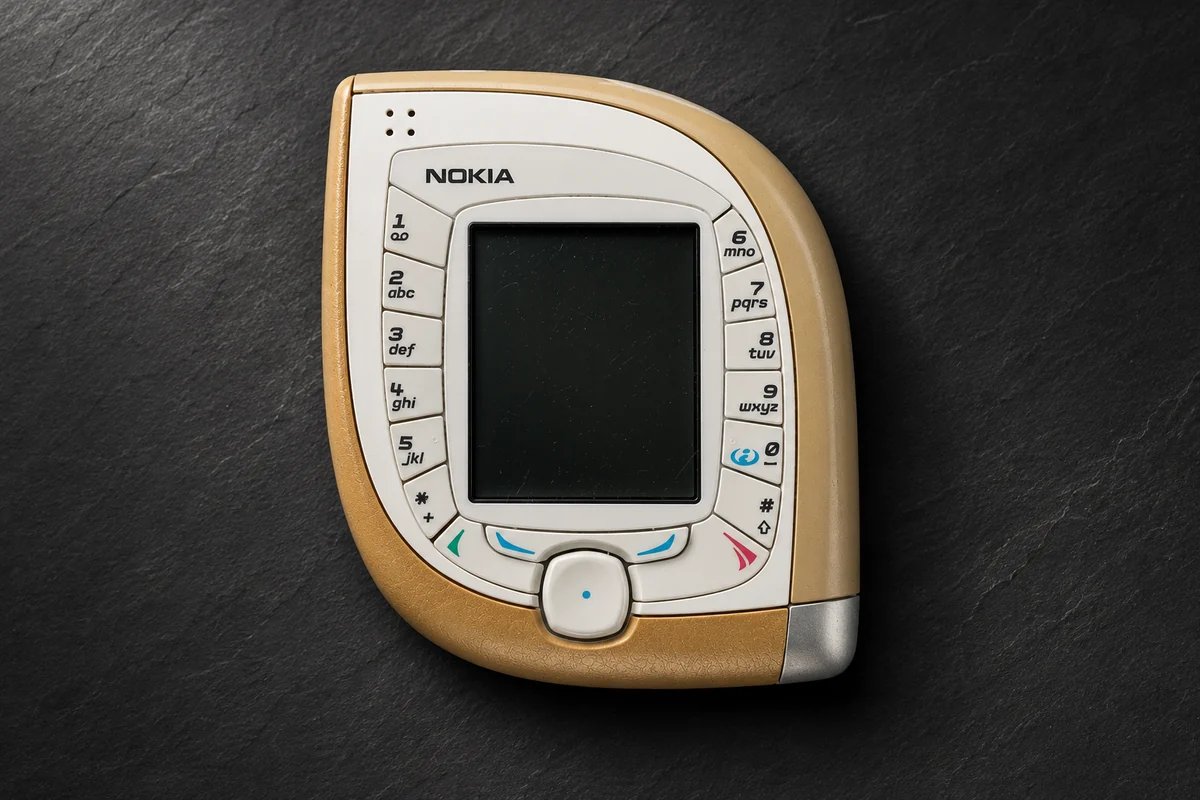
Buying budget: £60–£120; complete, boxed originals can cost more · Check eBay listings
The 2003 Nokia 7600 looks like an art-deco object that wandered into a phone shop. Its wide, rounded body puts number keys down both sides of the central screen. It is unforgettable in a way that another shade of modern smartphone grey will never be. [14]
It is also wonderfully awkward. Texting takes a little retraining, and one-handed use is not its strongest argument. That may suit an occasional-use detox phone, although we would choose the 6310i for comfort and keep the 7600 for the pleasure of owning it.
Check before buying: all the side keys and removable covers. Incomplete phones turn up in listings, so “working” should not distract you from a missing back. Its original 3G support does not rescue it from today’s shutdowns: UK use now needs its GSM capability, a compatible SIM and working local 2G coverage.
Nokia N-Gage: a detox with a game cartridge
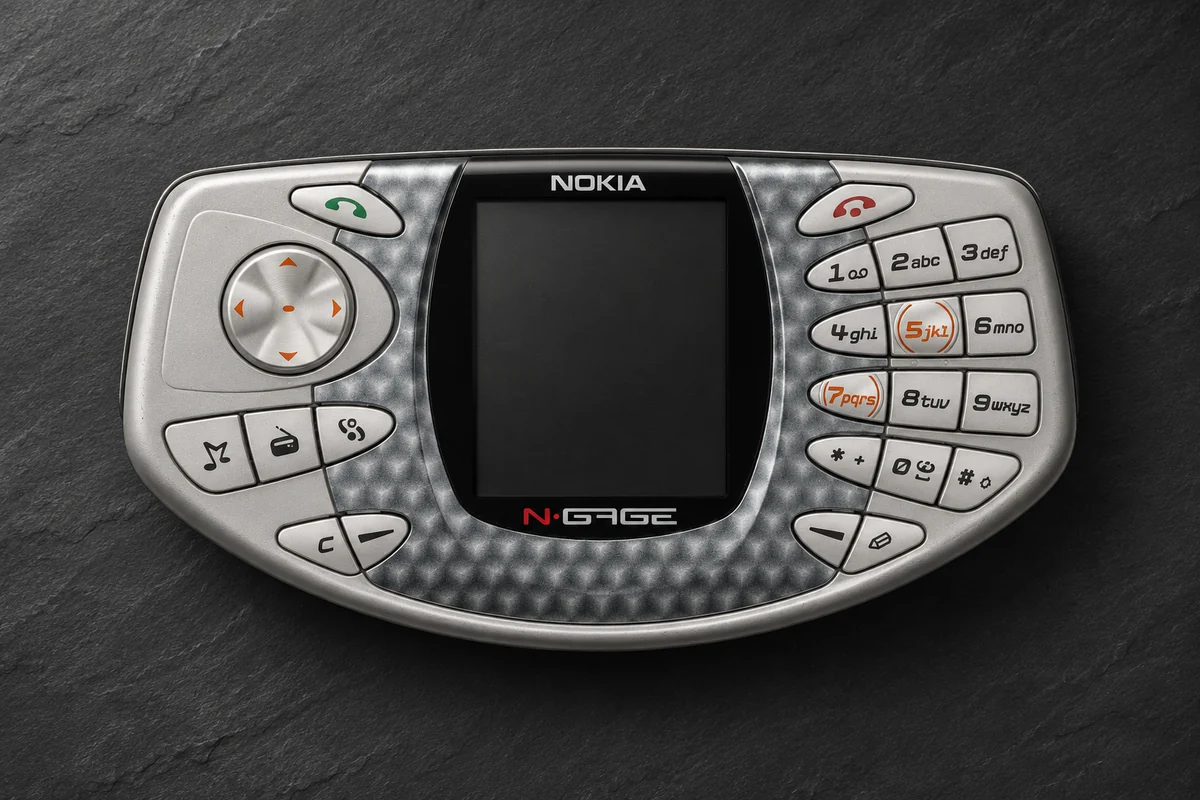
Buying budget: roughly £100–£180 for a working original; games and boxes add more · Check eBay listings
Nokia’s 2003 phone-and-console hybrid remains one of the most entertaining objects it ever made. The original N-Gage puts a portrait screen between the game controls and number pad, then asks you to hold its narrow edge to your ear for calls. “Sidetalking” was not a nickname people invented for no reason. [15]
This is a detox from feeds, not necessarily from screens. A few games you deliberately choose can be a pleasant change from an infinite queue of things you never meant to watch. Just be honest with yourself about which distraction you are trying to escape.
Check before buying: that it is the original N-Gage if sidetalking nostalgia is the goal—the later QD is different. Have the controls, speaker and game-card reading demonstrated, and establish exactly which games are included. Do not pay boxed-console money for an untested handset with a download promise.
Nokia 3250: give the music a twist
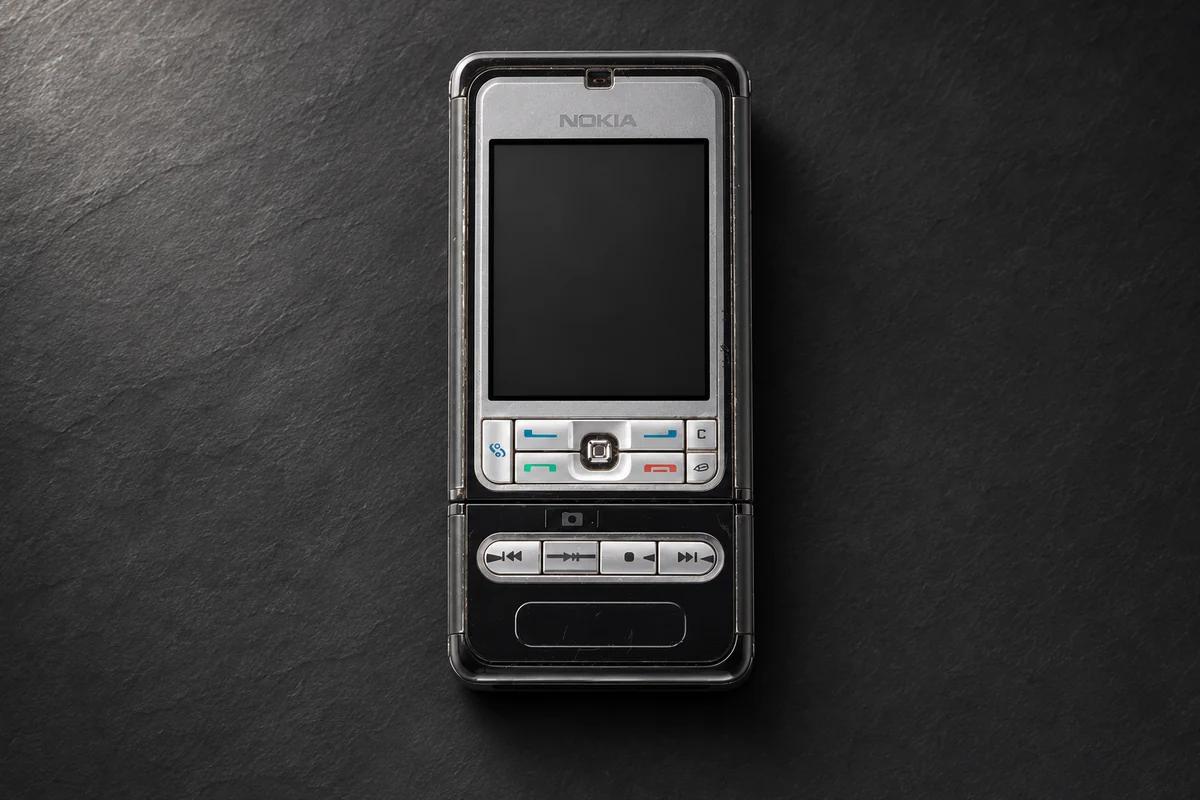
Buying budget: around £90–£140 for tested examples in the current listings · Check eBay listings
The 3250 turns changing modes into a physical action. Twist the lower section and the number pad gives way to music keys; the camera sits on another face of that rotating block. Announced in 2005 and sold from 2006, it is the phone for anyone who thinks gadgets should have moving parts. [16]
It makes a pleasing music-and-calls companion, with a little Rubik’s Cube energy every time you change your mind. Like the Walkmans, it is best approached as a player for your own files, rather than a route back to current apps and services.
Check before buying: the rotating section should move cleanly, settle into its positions and switch functions correctly. Ask for a video showing keypad, camera and music controls working. The unusually cheap listings may be faulty; the recent tested examples we found were appreciably above the old £30–£80 sort of budget.
3. The heavyweights: practical, cinematic and very posh
Nokia 7110: the satisfying thwack
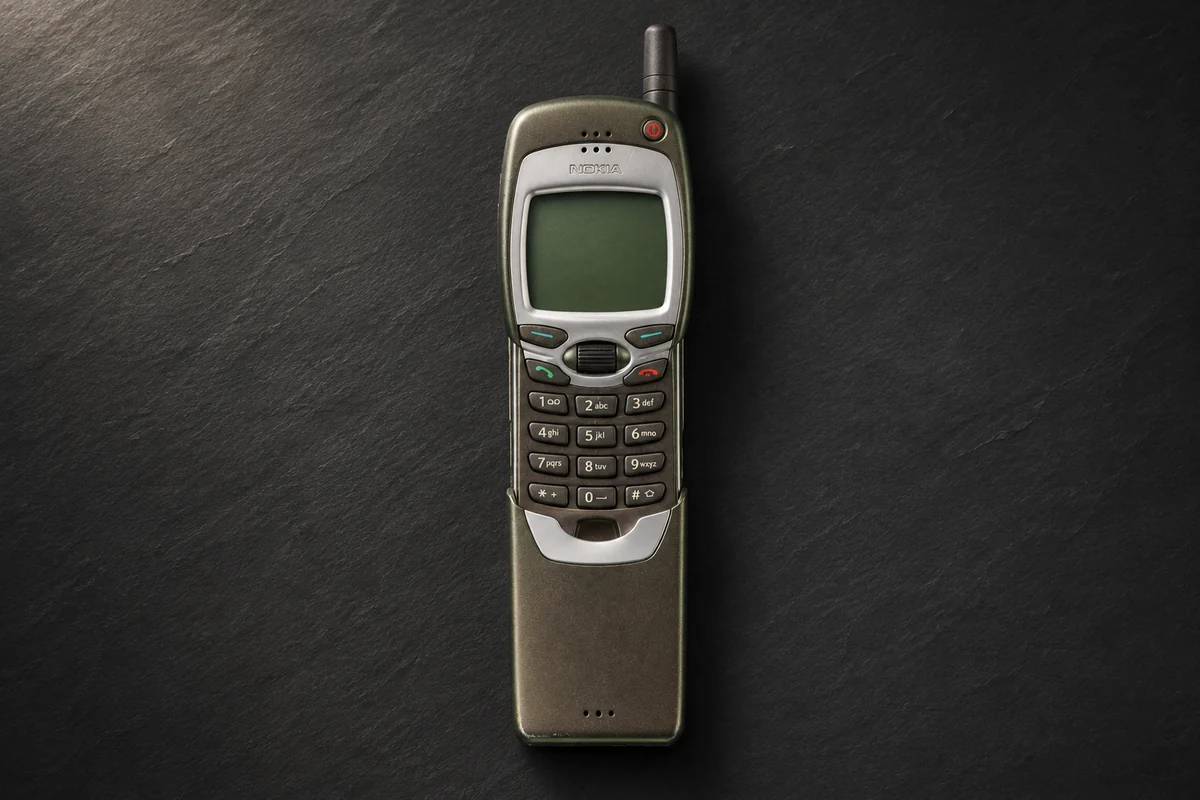
Buying budget: £45–£100; boxed or exceptional examples can reach £150+ · Check eBay listings
Press the release and the 7110’s keypad cover drops with a wonderfully purposeful thwack. It is the sort of mechanism that makes answering a call feel like the beginning of a scene. The big monochrome screen and little menu roller add to the appeal.
One correction worth making while we are here: The Matrix used a modified Nokia 8110, not the 7110. The film prop had a spring-loaded slide; the production 7110 brought that satisfying spring action to a phone people could actually buy. So the association makes sense, even though the model number often gets mixed up. [17]
For a detox, it offers a fairly conventional Nokia underneath the theatre. Check the release, slide rails, microphone and roller before buying. Ask for an actual call test as well as a video of the cover opening. A snappy slide is only half the story if nobody can hear you.
Vertu Ascent / Signature: expensive simplicity
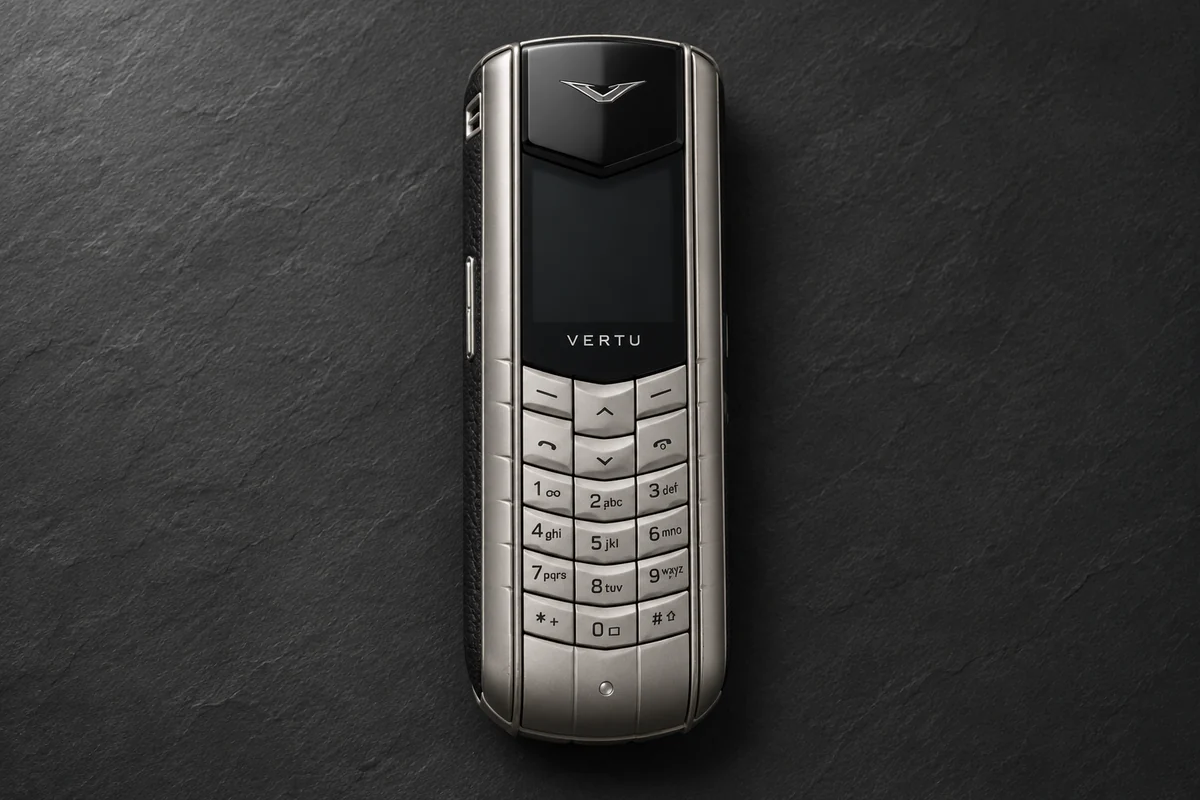
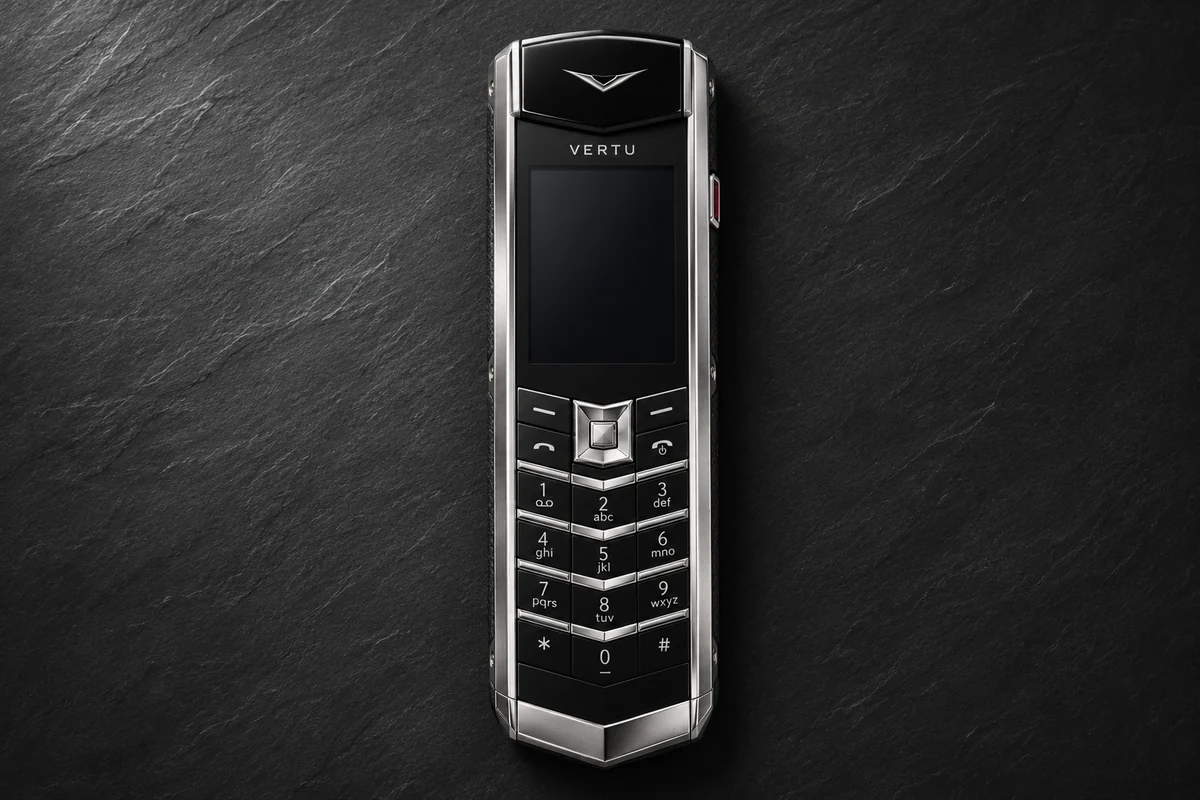
Buying budget: older Ascents from roughly £500; allow £3,000–£5,000+ for many Signature S listings · Check eBay listings
Vertu was Nokia’s luxury offshoot: the idea that a mobile could be made and bought more like a fine watch. The older English-built phones brought hand assembly, sapphire screen covers, leather and beautifully engineered keys to a device that might spend most of its life making calls.
Materials vary by model. The original Ascent used Liquidmetal alloy; later Ascent Ti versions used titanium. Signature models came in finishes including stainless steel and precious metals. “All Vertus are titanium” is a tempting shorthand, but it is not right. [18] [19]
As a detox choice, the appeal is gloriously excessive: spend serious money on a phone that does less. It can be a lovely object, but this is collector territory. The Signature S shown here is the classic keypad phone, not the later Signature Touch smartphone.
Buy the seller as carefully as the phone. Counterfeits, mixed parts and optimistic authenticity claims make a cheap “genuine Vertu” a poor place to gamble. Seek documented provenance, detailed photographs and specialist verification. Check battery and repair support before paying; neither a working concierge button nor a serial-number photo proves that the old services are included. Our Nokia history article follows the brand’s changes of ownership.
Nokia 6310i & 3310: the phones that get out of your way
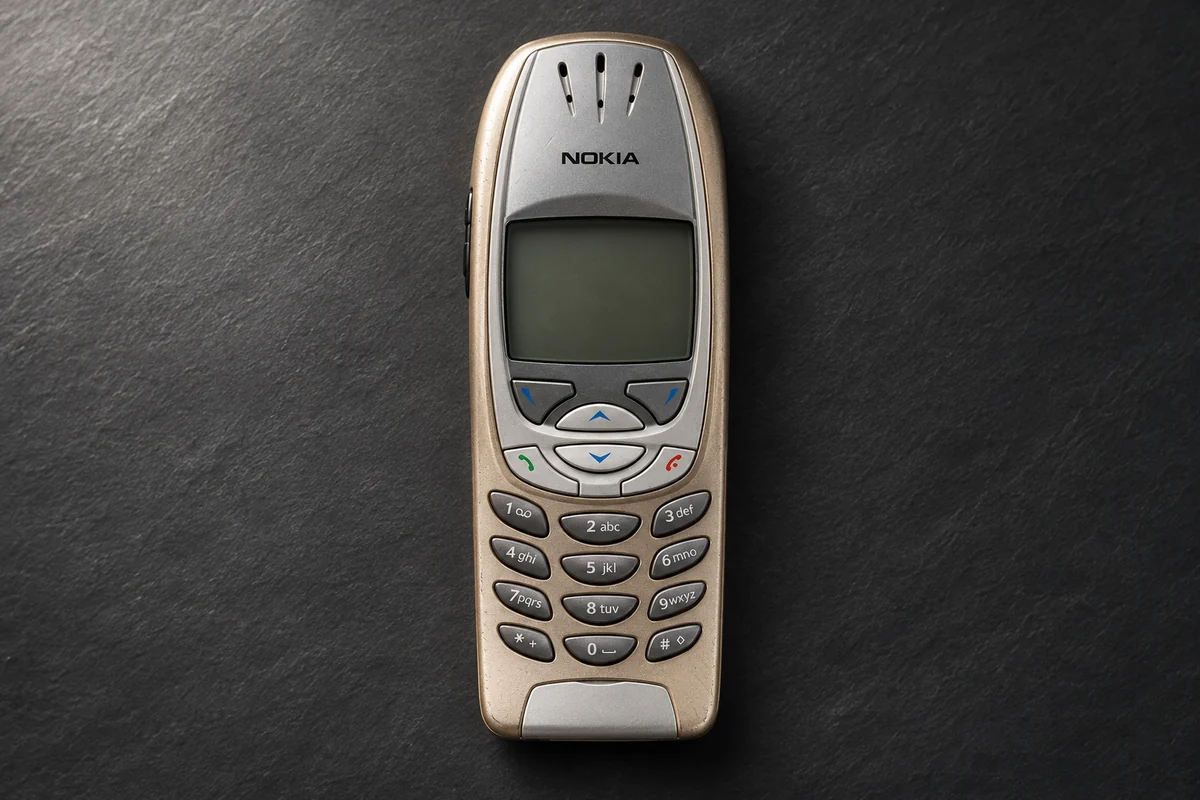
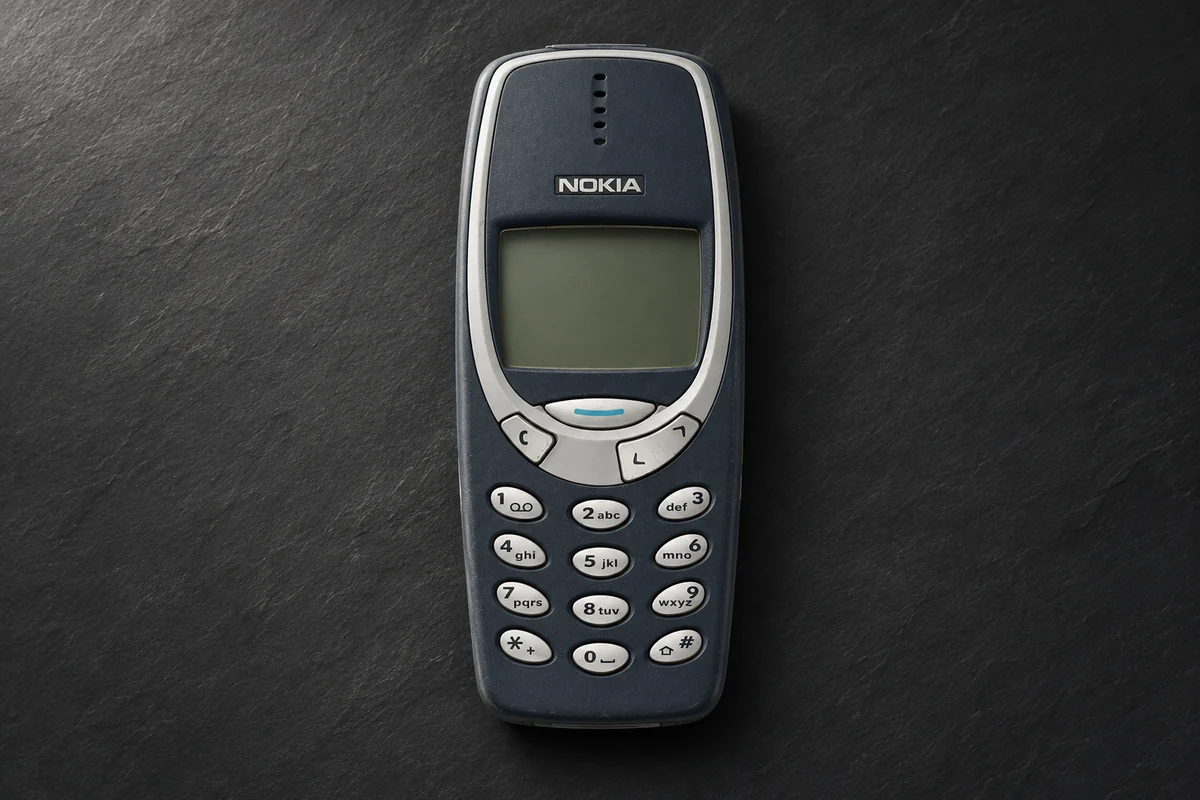
Buying budget: 3310: £20–£45 · 6310i: £30–£80 · Check eBay listings
The 6310i is the quiet professional. A tall, comfortable body, clear monochrome screen and sensible buttons make it an easy phone to live with. The original 3310 is the friendly one: familiar menus, changeable covers and Snake II. Neither needs to be rare to be a good buy.
These are our starting points for calls-and-texts weekends. Battery life was a big part of their appeal, but “two weeks between charges” needs context. Nokia quoted up to roughly two weeks of standby for some 6310i battery options; that is not two weeks of calls, and it is certainly not a promise about a twenty-year-old battery. With a healthy replacement and a good signal, days rather than hours is the sensible hope. [20]
Check before buying: that you are buying the original model, not a later phone reusing the name. Look for clean battery contacts, a working microphone and earpiece, all keys responding and a proper call test. A good original with honest wear can be a better buy than an implausibly pristine “new” handset.
An Orange or One2One badge need not end the story
Many old eBay finds are still locked to the network that first sold them. Orange and One2One branding is part of the nostalgia, but the SIM lock can stop a different network’s card working. This is exactly the kind of problem UnlockMe was built around.
For supported classic Nokia DCT3 and DCT4 models—including the original 3310, 6310i and 7110—our free original IMEI unlock calculator can generate the familiar #pw+…# codes. Select the exact handset and its original network, then follow the code-entry instructions. [22]
It is not a universal calculator for every phone in this guide: Motorola, Samsung, Sony Ericsson and BlackBerry are not covered, and later Nokia BB5 models such as the 3250 are outside its scope. Supported Nokias have a limited number of code attempts, so stop at an error and check the help. Unlocking also cannot remove an IMEI blacklist or bring a closed network back to life.
4. The reality check: before you buy
Choose the network before the SIM
As of November 2026, the UK’s 3G networks have been switched off. Compatible old phones can still make calls and send texts over 2G, but that has an end date too. The national plans currently look like this: [1]
| Network | Announced 2G plan |
|---|---|
| EE | Shutdown begins from May 2029. |
| O2 | Shutdown begins in summer 2029. |
| Vodafone | Switch-off in spring 2030. |
| Three | Has never operated a 2G network. |
Those are national timetables, not a promise that every local mast will run until the last day; earlier trial closures are planned. The often-quoted 2033 date is the latest industry deadline, not guaranteed service for your 3310 until then. [2]
Before ordering, ask the provider whether its current SIM and plan support 2G calls and texts in your exact handset. Check local coverage, then test incoming and outgoing calls and SMS during the seller’s return period. Smaller providers use the larger networks, so check which one sits underneath the brand. Do not assume a Three-branded SIM gains 2G access just because Vodafone and Three have merged.
Imported phones need the right UK GSM bands as well as an unlocked SIM slot. The StarTAC is a particularly easy trap, but US variants of other families need care too. A “4G SIM” does not upgrade a 2G handset. If this is to be your only phone for years, a modern basic phone with working 4G calling on your chosen network is the more practical long-term purchase.
Treat the battery as part of the purchase
A twenty-year-old battery may have very little useful capacity left. Age alone does not prove it is dangerous, but it is a good reason to budget for a replacement and inspect what arrives. “New old stock” can still mean an old battery that has spent years sitting in a box.
Look for a recently made, correctly specified replacement from a reputable supplier. A branded compatible battery can be the realistic option when genuine manufacturer stock no longer exists; a suspiciously huge capacity claim and a bargain price are not quality checks. Use a suitable, good-quality charger, and make the first charge somewhere you can keep an eye on it.
Do not charge a swollen, leaking or damaged pack. Stop using one that becomes unusually hot or develops a smell. Do not squeeze it flat, puncture it or put it in household rubbish; ask a battery recycling service how to handle a damaged pack safely. Avoid charging on bedding or leaving an unfamiliar old phone charging overnight. [21]
Ask for a working phone, not just a glowing screen
- A recent demonstration. For a phone you intend to use for calls, ask for incoming and outgoing calls, both-way audio, SMS and charging. For BlackBerry or Sidekick, ask specifically for the offline functions and setup state you need.
- Photos of the actual item. Front, back, battery compartment, connectors and the screen switched on. Check for corrosion, missing covers, a damaged SIM holder and replacement housings.
- The complete cost. Battery, charger, headset adapter and memory card can turn a cheap listing into a project. Confirm the correct battery is still obtainable before buying an unusual model.
- A clear description and return terms. “Untested” means untested. Treat it as a repair gamble, even if the seller says it worked when it went in the drawer.
- A usable SIM arrangement. Most of these want the larger mini-SIM size. Ask your provider about a suitable physical SIM, and use a well-fitting adapter if needed; do not force a loose adapter into old contacts.
Try a weekend before you move your whole life
Put a few important numbers in, tell people to call or text, and give the phone a Saturday. Keep a plan for banking, maps, parking, tickets and two-factor logins before leaving the smartphone behind. If your number normally receives iMessage or RCS messages, check the relevant deregistration settings when moving it to a basic phone.
There is no prize for making life unnecessarily difficult. A 3310 for a walk, a Walkman phone for a music-filled Sunday or a RAZR for an evening out can be enough. Pick something you enjoy using, then let it spend most of the day in your pocket.
Sources and buying notes
Dates, specifications and discontinued-service notices were checked for this draft on 8 November 2026. Price links throughout the profiles lead to eBay searches or listings; stock, condition and asking prices change. The illustrations are not photographs of phones being offered for sale.
- UK 2G dates and completed 3G shutdown — Ofcom, updated 4 November 2026
- Consumer advice on network changes — Ofcom
- BlackBerry legacy services: official end-of-life notice
- Danger service shutdown — T-Mobile, 2011
- Pink RAZR V3 — Mobile Phone Museum
- StarTAC — Science Museum Group collection
- Bold 9900 — Mobile Phone Museum
- W800 — Mobile Phone Museum
- Sony Ericsson W810i user manual (manufacturer manual, archived copy)
- Sidekick 3 launch — T-Mobile, 2006
- Chocolate KG800 — Mobile Phone Museum
- Samsung D500 — Mobile Phone Museum
- Nokia 7280 — Mobile Phone Museum
- Nokia 7600 — Mobile Phone Museum
- Original N-Gage — Mobile Phone Museum
- Nokia 3250 announcement, filed by Nokia with the SEC
- Nokia 7110 and the Matrix connection — Mobile Phone Museum
- Vertu construction and the Ascent material variants — Mobile Phone Museum
- Period Signature S materials — G.J. Wisdom auction inventory, 2019
- Nokia 6310i user guide and original battery estimates (archived manufacturer manual)
- Battery and charger safety — London Fire Brigade
- Supported models and code-entry instructions — UnlockMe calculator
- RAZR V3: period Motorola figures and a hands-on battery test — The Travel Insider, 2005
- StarTAC 130: manufacturer brochure figures reproduced by network operator Magti, 1999
- BlackBerry Bold 9900 specifications — AT&T product sheet
- W810 / W800i battery and connectivity comparison — Sony Ericsson white paper, 2006
- Sidekick 3 battery guidance — original Danger / T-Mobile reference guide, page 16
- Chocolate KG800 battery figures — LG press release
- D500 battery and connectivity specifications — archived Samsung UK product sheet
- Nokia 7280 battery figures — original Nokia user manual
- Nokia 7600 launch and battery figures — Nokia press release, 2003
- Original N-Gage battery, gaming and connectivity figures — Nokia press release, 2003
- Nokia 3250 battery and playback figures — original Nokia product leaflet
- Nokia 7110 battery options — original Nokia owner’s manual, page 91
- Original Vertu Ascent battery figures — Vertu user manual
- Classic Vertu Signature S battery figures — Vertu VM-06 user manual
- Original Nokia 3310 battery options — Nokia owner’s manual, 2000
- Nokia 8210 features, games and original battery figures — archived Nokia user guide
- Original Nokia 8210: announcement date and 79g weight — Mobile Phone Museum collection record
- Original Nokia 8210 asking-price examples — eBay UK listings, checked 8 November 2026