A tiny screen. A growing tail. And the irresistible promise of one more go.
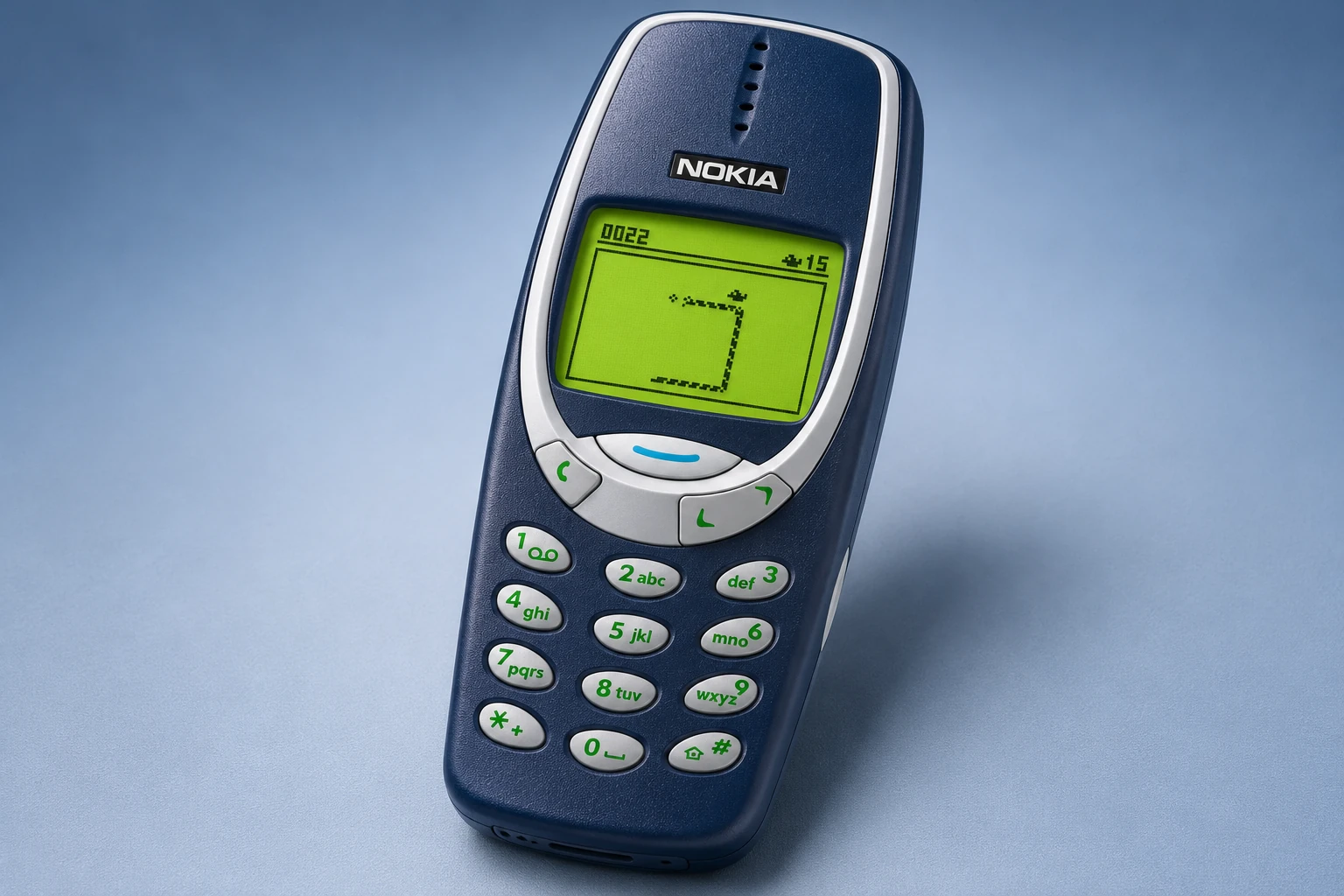
Some games sell a console. Snake helped turn an ordinary mobile phone into something you borrowed from a parent, passed around at school or quietly stared at while waiting for absolutely anything. The graphics were a handful of dark blocks. The plot was lunch. Somehow, that was enough.
Nokia did not invent the idea of Snake. What it did was put a beautifully simple version into the phones people were already carrying—and give a generation a reason to say, “Hang on, I’m nearly at my high score.”
Jump to: Play Snake · The story · The handsets · High scores · Snake II · Later versions
First, have a go
We have built a little UnlockMe tribute to that familiar challenge. Have a quick go below, or open full screen mode for more room to play.
Before Nokia, there was already a snake
The family tree reaches back to Blockade, a two-player arcade game released by Gremlin in 1976. Players left trails behind them and tried to avoid a collision. Related ideas spread through home computers, gradually giving us the familiar eat, grow and avoid-yourself formula. [3]
Taneli Armanto created Nokia’s influential version, not the entire genre. He has also pointed out that other manufacturers had put games on phones before Nokia. [2]
The engineer, the 6110 and the game that fitted
Nokia dates the creation of its Snake to 1997, for the Nokia 6110. In a later interview, Armanto recalled the handset going on sale at the beginning of 1998. That is why both years sometimes appear in accounts of its arrival. [1][2]
Armanto worked on handset software, and the games were his part of the job while colleagues tackled things such as the phone book and calculator. He first tried Tetris, but its proposed licensing arrangement did not work for Nokia. Snake fitted the small screen, limited controls and modest resources available. [2]
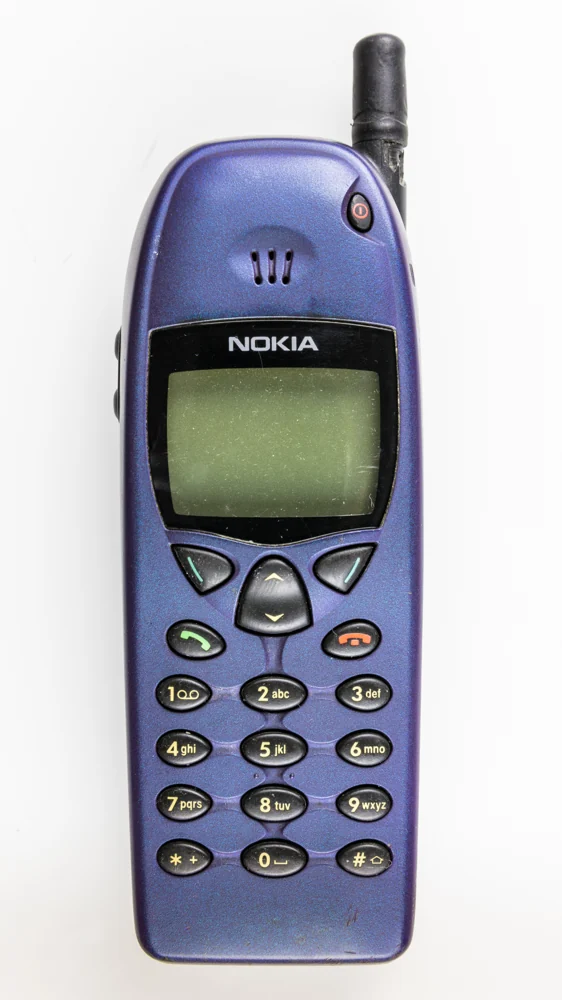
A businesslike phone with a surprisingly entertaining extra.
© Raimond Spekking / CC BY-SA 4.0 (via Wikimedia Commons). Resized and converted to WebP.

Armanto even added a tiny grace period before a collision, giving players a last chance to turn. The hardest setting pushed the handset’s speed; slower settings left more time between moves. [2]
The 6110 also offered an infrared connection, and Nokia wanted the game to make use of it for play between phones. Even at this early stage, the appeal of challenging another person was part of the thinking. [1]
The phones that took Snake everywhere
The 6110 deserves its place at the start of the story, but Snake did not become a shared memory through one handset alone. The next wave of Nokia phones put it in far more everyday pockets. If your first mobile had a changeable cover and a favourite ringtone, this is probably the part you remember.
| Handset | Its part in the story |
|---|---|
| Nokia 6110 1997–98 | The starting point for Nokia’s Snake: the handset for which Armanto created the game, including the possibility of playing between phones using infrared. [1][2] |
| Nokia 5110 1998 | A consumer-market Nokia with Snake built in. The Science Museum’s collection identifies both that mainstream audience and the game as central parts of its story. [15] |
| Nokia 3210 1999 | The familiar successor with a built-in antenna and an appeal to younger phone owners. Snake sat in the Games menu alongside Memory and Rotation: no download, subscription or separate purchase required. [16][18] |
| Nokia 3310 2000 | The handset so many people picture when they think of Nokia gaming. It carried Snake II, and Nokia’s own retrospective put 3310 sales at 126 million. [6][17] |
So which phone made Snake famous? The best answer is a sequence: the 6110 introduced Nokia’s version, the 5110 and 3210 helped bring it to the mass market, and the 3310 became one of its most recognisable homes. That wider distribution helps explain how a small extra in the menu became a worldwide habit.
One number is easy to muddle: Nokia’s estimate of around 350 million Snake-equipped phones in 2005 covered the game across its handset range. It was not a claim that 350 million original 3310s had been sold. [1][17]
How a little extra became the main attraction
The clever part was that Snake was already there. You did not need to decide you were a gamer, buy a separate machine or hunt for something to download. A spare minute and a charged phone were enough. Its rules could be understood almost immediately, while a good run still demanded concentration.
Then there was the delicious trap in the design: every success made the next move harder. Eating was good, but growing left you less room. You were building your own obstacle course, one bite at a time. A mistake felt avoidable, which made another attempt terribly easy to justify.
The scale was extraordinary. In June 2005, Nokia estimated that around 350 million phones in the market carried Snake. By its 2012 retrospective, the company was talking about more than 400 million phones. Those are handset figures, not a count of unique players, but they show how powerful being built in could be. [1][3]
For many people, a high score became a tiny badge of honour. You could compare numbers with a friend, hand over the phone and immediately regret it when they beat yours. No online leaderboard was required.
How high did the scores actually get?
First, the important bit: there is no single score that works across every Snake game. The original, Snake II and later remakes have different rules, boards and scoring. Even the original’s speed setting changes the points available.
| Score | What it tells us |
|---|---|
| 2,008 | The original Nokia Snake’s maximum at level 9, according to Nokia’s published formula. Armanto also recalled roughly 30 Australian competition entrants reporting maximum scores. [3][5] |
| 312 | The corresponding maximum at level 1. A smaller number does not necessarily mean a less complete game. [3] |
| 1,044 | The score that won Finland’s 1999 Snake championship, as reported in Yle’s archive. It was a competition result, not the game’s theoretical ceiling. [4] |
| Snake II | A different scoring system. We could not verify a definitive, current world-record holder from an authoritative record listing, so we are not presenting a circulating claim as a certified record. |
For the original, Nokia published the calculation as 212 × level + 100 completion points. At level 9 that makes 2,008; at level 1 it makes 312. This is a description of that game’s maximum, not a formula to apply to every later Snake. [3]
The Australian story is particularly good. In a 2014 interview with Finnish games magazine Pelit, Armanto recalled organisers expecting only a handful of finalists, then receiving around 30 maximum-score claims. They asked him whether the phones could have been hacked. His response was that a country the size of Australia could perfectly well contain dozens of players that good. These are his recollections of the competition, rather than a surviving public leaderboard naming every player. [5]
Finland’s Snake championship: were you there?
Finland’s contests were serious business too. Yle’s archive describes qualifying rounds in 12 locations and roughly 40 finalists in 2000. The previous year’s winning 1,044 had already been comfortably surpassed in qualifying. The winner’s prizes included a Nokia 3310 with accessories and a trip to the Alps with a friend. Quite a reward for chasing pixels. [4]
Nokia’s original announcement adds a lovely detail: players had five minutes to chase their best score, chose their own difficulty level and could use Nokia 3210 handsets supplied by the organisers. You did not even need to own a phone to have a go. [19]
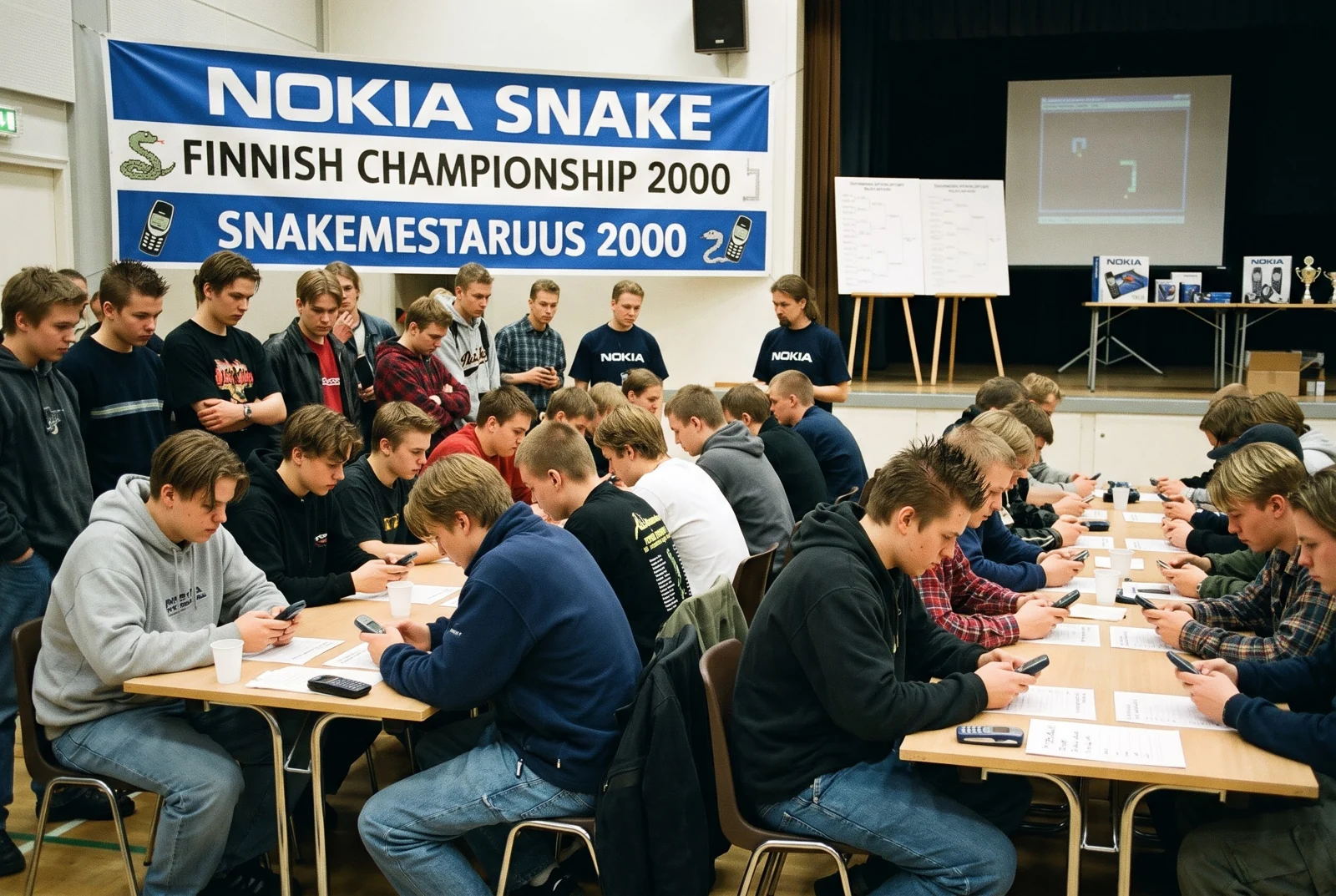
There is still a name missing from our story: we haven’t yet verified who won the 2000 Finnish championship. Nokia’s announcement and Yle’s written recap preserve some wonderful details, but neither names the winner. Perhaps someone reading this can help us put a name to that high score. [4][19]
Were you there — or do you know someone who was? If you took part, helped organise the event or have a results sheet, newspaper clipping or genuine photographs, please contact us and tell us what you have. We would love to add verified names, memories and original pictures to the story, with permission and credit to the people who share them.
What about the 9,254-point “world record” online? That number is repeated in articles about the Nokia 3310. We found the claim, but not the underlying official record needed to confirm the player, version and conditions. It is best treated as unverified, rather than mixed in with Nokia’s documented original-game maximum. [12]
Snake II: the version many of us remember
Ask someone to picture “old Nokia Snake” and they may actually be remembering Snake II on the Nokia 3310. Nokia’s own 3310 guide lists it alongside Space Impact, Bantumi and Pairs II, with options for the top score, difficulty and continuing a paused game. [6]
The follow-up kept the instantly recognisable chase but introduced more variety, including maze walls. That changed the rhythm: it was no longer only your growing body that could get in the way. You had to learn the board as well. [4][5]
Snake II also became associated with travelling through the screen edges and appearing on the opposite side on an open board. That sounds like a favour until your tail is waiting for you over there. The extra routes gave you more choices—and more opportunities to make a very confident mistake. [13]
It is easy to talk about all of this as one engineer steadily upgrading his game, but Armanto told Pelit that later development moved to other teams. The original was his project; the family that followed became a bigger undertaking. [5]
Where Snake went next
The name stayed familiar even as the phones became more capable. This is a selection of the main turns in the story, rather than a list of every handset or regional software release.
| Version / era | The next step |
|---|---|
| Snake 1997–98 | Nokia’s original 6110 game: a simple concept adapted to a phone, with later mass-market handsets carrying it much further. [1][2] |
| Snake II 3310 era | The monochrome follow-up remembered for mazes and the 3310. The manual confirms the game and its high-score, level and pause options. [4][6] |
| Snake EX / EX2 Early 2000s | The family expanded with colour-era versions. Nokia’s 2003 announcement specifically lists Snake EX2 among the Java games supplied with the colour-screen 3100. [7][14] |
| Snakes 2005 | A 3D reinvention for N-Gage, offered as a free download with Bluetooth sharing and multiplayer for up to four people. [8] |
| Snakes Subsonic 2008 N-Gage era | Another branch of the series, included in Nokia’s announced line-up for its new N-Gage games service. [9] |
| Snake Rewind 2015 | Armanto teamed up with Rumilus Design. Among the new ideas was the ability to rewind after a crash and try again from before the mistake. [10] |
| Snake returns 2017 | HMD brought Snake back with the revived Nokia 3310. Gameloft made that handset version; CoolGames made the separate Messenger edition. [11] |
There were other familiar names along the way, including Snake Xenzia and Snake III. Nokia’s Snake family was a collection of versions for different generations of phone, rather than one identical game with a new number each time. [14]
The 2017 return is especially telling. A modern 3310 could have arrived with any small game, but Snake was part of what made it feel like a Nokia. The game had become part of the handset’s identity. [11]
A few tips before your next attempt
Keep some space for the journey back. The shortest route to the next food is not always the safest one if it leaves your head trapped inside a loop. Broad, tidy sweeps often give you more options than a collection of frantic little corners.
The article game uses Classic walls at Steady speed. Full screen mode lets you choose a different handset, mode or speed. In our version, food is worth 10 points at every speed, and each combination of mode and speed has its own personal best. These scores are not directly comparable with the original Nokia records.
Touch: swipe the screen to steer.
Why we still fancy one more go
Snake is a reminder that a game does not need much explanation to make a strong impression. Nokia put a short, satisfying challenge into a device that people already had a reason to carry. The screen was small, but the opportunity was enormous.
For UnlockMe, it belongs beside the interchangeable covers, familiar ringtones and well-worn keypads in the story of those phones. It also has one advantage over a photograph of an old handset: you can still find out, within about thirty seconds, whether your thumbs remember what to do.
More Nokia nostalgia: The rise and fall of Nokia.
Sources and picture credit
Original Nokia announcements, handset documentation and interviews are used where available. Historical estimates and competition recollections are labelled as such. The game above is an original UnlockMe tribute, not Nokia software or an official Nokia release. Research checked 7 November 2026.
- Nokia: Snake creator receives Mobile Entertainment Forum recognition, 16 June 2005
- MEL Magazine: first-person interview with Taneli Armanto, 12 September 2019
- Nokia Conversations archive: Snake facts and original scoring formula, 2 February 2012
- Yle archive: Armanto interview and Finnish championship coverage (Finnish), updated 27 August 2025
- Pelit: interview with Armanto, including Australian maximum-score players (Finnish), 10 February 2014
- Nokia 3310 user guide: Games, page 80 (archived PDF)
- Nokia 3100 announcement: Snake EX2, 16 June 2003
- Nokia: Snakes for N-Gage, 25 January 2005
- Nokia: N-Gage service and Snakes Subsonic launch line-up, 7 April 2008
- Microsoft Devices Blog: Snake Rewind launch, 14 May 2015
- HMD Global: Snake returns on Messenger and the new 3310, 27 February 2017
- Gamer Journalist: example of the circulating 9,254-point claim, 24 October 2023 (not independently verified here)
- OCR Computing exemplar: Snake II screen-edge behaviour and design reference, page 14 (archived PDF)
- Stuff: retrospective list of Nokia Snake versions, 2011
- Science Museum Group: Nokia 5110, consumer market and Snake, 1998
- Nokia 3210 user guide: Games, page 58, 1999 (archived PDF)
- Nokia Conversations: the evolution of Snake and 3310 sales, 25 November 2010
- Mobile Phone Museum: Nokia 3210 design, launch and games
- Nokia: second Finnish Snake championship announcement, rules and supplied Nokia 3210 handsets (Finnish), 4 October 2000